Back

Glycoconjugates definitions

Control buttons has been changed to "navigation" mode.
1/15
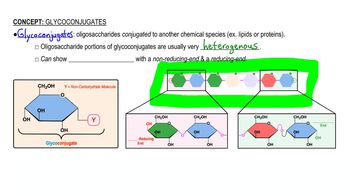
  • Glycoconjugate

    Oligosaccharide covalently attached to a non-carbohydrate molecule, such as a lipid or protein, forming a hybrid structure.
  • Oligosaccharide

    Short carbohydrate chain composed of multiple sugar units, often heterogeneous in glycoconjugates.
  • Heterogeneity

    Presence of different types of sugar units within an oligosaccharide, contributing to structural diversity.
  • Directionality

    Characteristic of oligosaccharides with chemically distinct ends, including reducing and non-reducing termini.
  • Reducing End

    Terminal sugar with a free anomeric carbon bonded to two oxygen atoms, capable of forming a hemiacetal group.
  • Non-Reducing End

    Terminal sugar lacking a free anomeric carbon, typically bonded to only one oxygen atom.
  • Glycolipid

    Hybrid molecule consisting of a lipid covalently linked to an oligosaccharide, often involved in cell signaling.
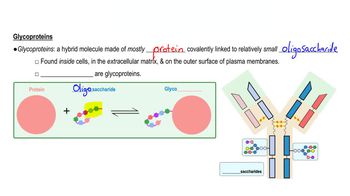
  • Glycoprotein

    Hybrid molecule composed of a protein covalently attached to a small oligosaccharide, found in various cellular locations.
  • Extracellular Matrix

    Complex network outside cells where glycoproteins are commonly located, providing structural and functional support.
  • Plasma Membrane

    Cellular boundary where glycoproteins are present, contributing to cell surface properties and interactions.
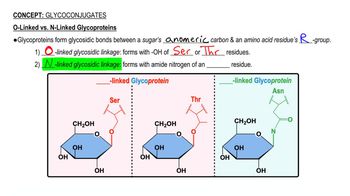
  • O-Linked Glycoprotein

    Glycoprotein with oligosaccharide attached via the hydroxyl group of serine or threonine amino acid side chains.
  • N-Linked Glycoprotein

    Glycoprotein with oligosaccharide attached through the amide nitrogen of asparagine amino acid side chains.
  • Glycosidic Bond

    Covalent linkage formed between the anomeric carbon of a sugar and a functional group on another molecule.
  • Anomeric Carbon

    Carbon atom in a sugar ring bonded to two oxygen atoms, crucial for forming glycosidic linkages.
  • Hybrid Molecule

    Structure composed of two distinct molecular types, such as a carbohydrate linked to a lipid or protein.