Back

Glycoconjugates quiz

Control buttons has been changed to "navigation" mode.
1/15
  • What are glycoconjugates?

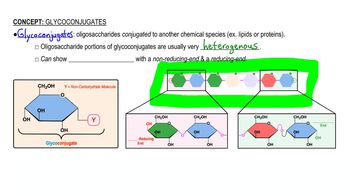
    Glycoconjugates are oligosaccharides covalently linked to non-carbohydrate molecules, such as lipids or proteins.
  • What does it mean when oligosaccharides in glycoconjugates are described as heterogeneous?

    It means they are made up of more than one type of sugar, not all the same kind.
  • What is the difference between the reducing end and the non-reducing end of an oligosaccharide?

    The reducing end has a free anomeric carbon, while the non-reducing end does not.
  • What is a glycolipid?

    A glycolipid is a hybrid molecule made of a lipid covalently attached to an oligosaccharide.
  • What is a glycoprotein?

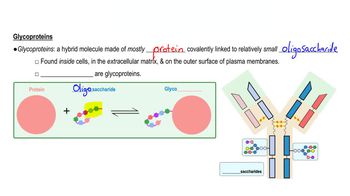
    A glycoprotein is a hybrid molecule composed of a protein covalently linked to a small oligosaccharide.
  • Where can glycoproteins be found in cells?

    Glycoproteins can be found inside cells, in the extracellular matrix, and on the outer surface of plasma membranes.
  • What are the two main types of glycoproteins based on their linkage?

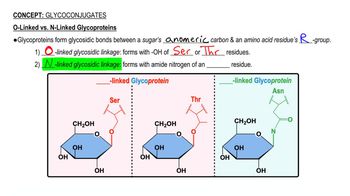
    The two main types are O-linked and N-linked glycoproteins.
  • How are O-linked glycoproteins formed?

    O-linked glycoproteins are formed when the oligosaccharide is linked to the hydroxyl group of serine or threonine's R group.
  • How are N-linked glycoproteins formed?

    N-linked glycoproteins are formed when the oligosaccharide is linked to the amide nitrogen of asparagine's R group.
  • What is the role of the anomeric carbon in glycoprotein linkages?

    The anomeric carbon of the sugar forms a covalent bond with the amino acid residue in the protein.
  • What does the 'glyco' prefix in glycoconjugates refer to?

    The 'glyco' prefix refers to the carbohydrate (sugar) portion of the molecule.
  • What does the 'conjugate' part of 'glycoconjugate' refer to?

    It refers to the non-carbohydrate molecule (such as a lipid or protein) that is covalently linked to the sugar.
  • Why do oligosaccharides in glycoconjugates show directionality?

    They show directionality because one end is chemically different from the other, having a reducing and a non-reducing end.
  • What is an example of a glycoprotein mentioned in the lesson?

    Antibodies are an example of glycoproteins.
  • What is the significance of oligosaccharides in antibodies?

    Oligosaccharides contribute to the diversity and function of antibodies.