Back

Hemoglobin Cooperativity definitions

Control buttons has been changed to "navigation" mode.
1/15
  • Hemoglobin

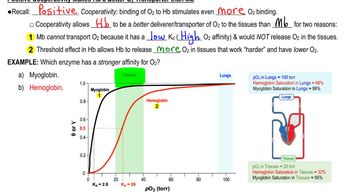
    Protein with four subunits, displays positive cooperativity and sigmoidal oxygen binding, optimizing oxygen delivery to tissues.
  • Myoglobin

    Single-subunit protein with hyperbolic oxygen binding, high affinity, poor oxygen release to tissues, lacks cooperativity.
  • Positive Cooperativity

    Phenomenon where binding of one ligand increases affinity for additional ligand binding in multi-subunit proteins.
  • Sigmoidal Curve

    S-shaped plot representing hemoglobin's oxygen binding, indicating cooperative ligand binding behavior.
  • Hyperbolic Curve

    Rectangular plot seen in myoglobin's oxygen binding, reflecting non-cooperative ligand binding.
  • T State

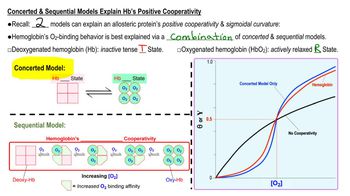
    Conformation of hemoglobin with low oxygen affinity, prevalent at low partial pressures, termed tense state.
  • R State

    Conformation of hemoglobin with high oxygen affinity, prevalent at high partial pressures, termed relaxed state.
  • Allosteric Protein

    Protein whose function is regulated by conformational changes induced by ligand binding at specific sites.
  • Concerted Model

    Theory where all subunits of a protein transition between states simultaneously, explaining cooperative binding.
  • Sequential Model

    Theory where subunits change conformation individually, with neighboring subunits gaining increased affinity.
  • Partial Pressure of Oxygen

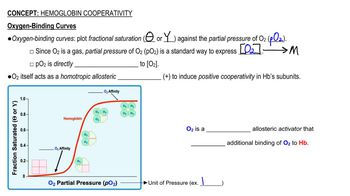
    Measurement of oxygen concentration in gases, directly proportional to hemoglobin's oxygen affinity.
  • Fractional Saturation

    Ratio indicating proportion of protein binding sites occupied by ligand, plotted on oxygen binding curves.
  • Threshold Effect

    Ability of hemoglobin to release more oxygen to tissues with lower oxygen levels, optimizing delivery.
  • Homotrophic Allosteric Activator

    Ligand that enhances its own binding to a protein, as oxygen does for hemoglobin.
  • BPG

    Heterotrophic allosteric effector that increases hemoglobin's oxygen release to tissues, enhancing transport efficiency.