Back

Hemoglobin Carbonation & Protonation definitions

Control buttons has been changed to "navigation" mode.
1/15
  • Hemoglobin

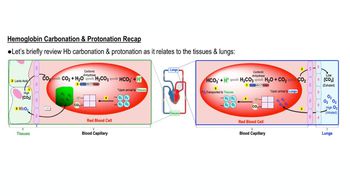
    Protein in red blood cells with four subunits, each capable of binding oxygen, carbon dioxide, or protons depending on tissue or lung environment.
  • Carbonation

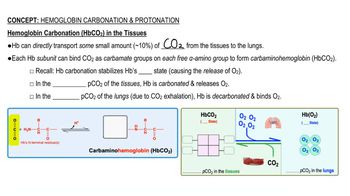
    Process where carbon dioxide binds to hemoglobin’s free alpha amino groups, forming carbaminohemoglobin and stabilizing the T state.
  • Carbaminohemoglobin

    Hemoglobin molecule with carbamate groups attached, enabling direct transport of carbon dioxide from tissues to lungs.
  • Protonation

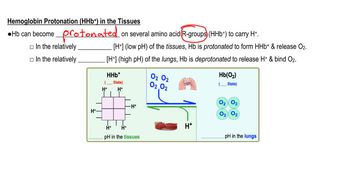
    Addition of hydrogen ions to hemoglobin’s amino acid R groups, increasing protonation sites and stabilizing the T state in tissues.
  • T State

    Conformation of hemoglobin with low oxygen affinity, stabilized by carbonation or protonation, facilitating oxygen release in tissues.
  • R State

    Conformation of hemoglobin with high oxygen affinity, favored in lungs due to low carbon dioxide and hydrogen ion concentrations.
  • Alpha Amino Group

    Site on each hemoglobin subunit where carbon dioxide attaches during carbonation, forming carbamate groups.
  • Carbamate Group

    Functional group formed when carbon dioxide binds to hemoglobin’s alpha amino group, crucial for CO2 transport.
  • Amino Acid R Group

    Side chain on hemoglobin susceptible to protonation, providing multiple sites for hydrogen ion binding.
  • Partial Pressure

    Measurement of gas concentration, with high values in tissues promoting carbonation and protonation, and low values in lungs favoring oxygen binding.
  • Decarbonation

    Release of carbon dioxide from hemoglobin in the lungs, enabling transition to the R state and oxygen uptake.
  • Deprotonation

    Release of hydrogen ions from hemoglobin in the lungs, facilitating oxygen binding and transition to the R state.
  • HHb+

    Form of hemoglobin carrying extra protons, prevalent in tissues with high hydrogen ion concentration.
  • HbCO2

    Form of hemoglobin bound to carbon dioxide, present in tissues and responsible for direct CO2 transport.
  • pH

    Indicator of hydrogen ion concentration; low values in tissues promote protonation, while high values in lungs favor deprotonation and oxygen binding.