Back

Lipid-Linked Membrane Proteins quiz

Control buttons has been changed to "navigation" mode.
1/15
  • What defines a lipid-linked membrane protein?

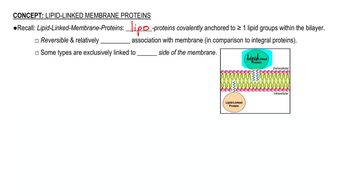
    A lipid-linked membrane protein is a peripheral protein covalently attached to at least one lipid group within the lipid bilayer.
  • How does the membrane association of lipid-linked proteins compare to integral membrane proteins?

    Lipid-linked proteins have a reversible and relatively weak association with the membrane, unlike the strong, tight association of integral membrane proteins.
  • What are the four types of lipid-linked membrane proteins?

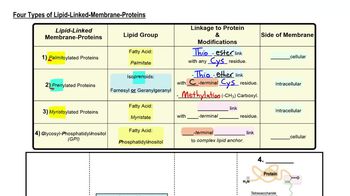
    The four types are palmitoylated, prenylated, myristoylated, and GPI-linked proteins.
  • Which amino acid residue is involved in the linkage of palmitoylated and prenylated proteins?

    Cysteine is the amino acid residue involved, as it contains a sulfur atom necessary for thioester or thioether linkages.
  • What type of covalent linkage is found in palmitoylated proteins?

    Palmitoylated proteins have a thioester linkage to any cysteine residue in the protein.
  • To which lipid group are prenylated proteins covalently attached?

    Prenylated proteins are covalently attached to isoprenoids, specifically farnesyl or geranylgeranyl groups.
  • Where on the protein does the prenylation linkage occur?

    Prenylation occurs at the C-terminal cysteine residue of the protein.
  • What additional modification occurs to prenylated proteins after linkage?

    The C-terminal carboxyl group of prenylated proteins is methylated, adding a CH3 group.
  • What type of linkage is found in myristoylated proteins and to which residue?

    Myristoylated proteins have an amide linkage to the N-terminal glycine residue.
  • Which side of the membrane are palmitoylated, prenylated, and myristoylated proteins typically found?

    These three types are typically found on the intracellular side of the membrane.
  • What is the lipid anchor in GPI-linked proteins?

    GPI-linked proteins are anchored via a glycosylphosphatidylinositol group, a complex glycerophospholipid.
  • How are GPI-linked proteins attached to the protein?

    They are attached via an amide linkage to the C-terminal end of the protein.
  • On which side of the membrane are GPI-linked proteins found?

    GPI-linked proteins are found on the extracellular side of the membrane.
  • What distinguishes the thioester linkage in palmitoylated proteins from the thioether linkage in prenylated proteins?

    Thioester linkages involve a carbonyl group bonded to sulfur, while thioether linkages have sulfur bonded to two carbon atoms without a carbonyl group.
  • Why are lipid-linked membrane proteins considered a subcategory of peripheral membrane proteins?

    They are considered peripheral because they are attached to the membrane surface via lipid anchors rather than being embedded within the membrane like integral proteins.