Back

Peptide Group definitions

Control buttons has been changed to "navigation" mode.
1/15
  • Peptide Bond

    An amide covalent linkage with partial double bond character, restricting rotation and contributing to protein backbone rigidity.
  • Peptide Group

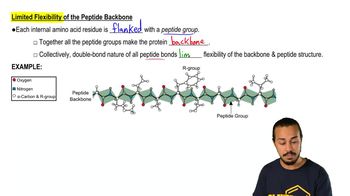
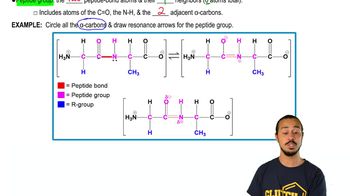
    A set of six atoms including the peptide bond, carbonyl, amino, and two alpha carbons, forming a planar unit in protein structure.
  • Carbonyl Group

    A functional group within the peptide group, consisting of a carbon double-bonded to oxygen, contributing to resonance and polarity.
  • Amino Group

    A nitrogen-containing group adjacent to the peptide bond, involved in resonance and partial charge distribution within the peptide group.
  • Alpha Carbon

    The central carbon atom in an amino acid, flanking the peptide group and connecting to the R group.
  • Resonance

    Electron delocalization within the peptide group, resulting in partial double bond character and polarization of the peptide bond.
  • Partial Double Bond Character

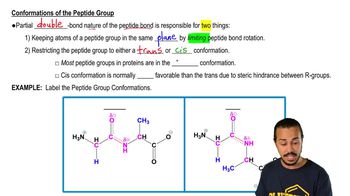
    A property of the peptide bond due to resonance, causing restricted rotation and maintaining planarity of the peptide group.
  • Planarity

    A structural feature where all atoms of the peptide group lie in the same plane, enforced by the double bond nature of the peptide bond.
  • Trans Conformation

    A spatial arrangement where bulky groups are on opposite sides of the peptide bond, favored due to reduced steric hindrance.
  • Cis Conformation

    A spatial arrangement where bulky groups are on the same side of the peptide bond, less favorable due to increased steric hindrance.
  • Steric Hindrance

    Physical crowding of atoms or groups, influencing the preference for trans over cis conformation in peptide groups.
  • Proline Residue

    An amino acid with a cyclic R group, allowing both cis and trans conformations in peptide groups due to similar steric effects.
  • Dipole Moment

    A separation of charge across the peptide bond, resulting from resonance and partial charges on the carbonyl oxygen and amino nitrogen.
  • Protein Backbone

    A linear chain of peptide groups, whose flexibility is limited by the partial double bond character of peptide bonds.
  • R Group

    A side chain attached to the alpha carbon, varying among amino acids and affecting steric interactions in peptide group conformations.