Back

Peptide Group quiz

Control buttons has been changed to "navigation" mode.
1/15
  • What type of covalent linkage is a peptide bond?

    A peptide bond is an amide covalent linkage.
  • How many atoms make up the peptide group, and which atoms are they?

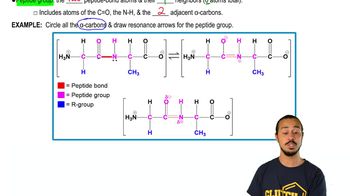
    The peptide group consists of 6 atoms: 2 from the peptide bond and 4 neighboring atoms (carbonyl, amino, and 2 alpha carbons).
  • What is the effect of resonance on the peptide bond?

    Resonance gives the peptide bond partial double bond character and makes it polarized.
  • Why does the peptide bond have restricted rotation?

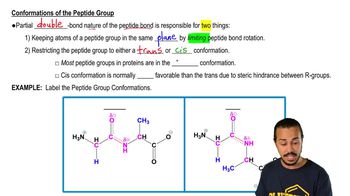
    The partial double bond character from resonance restricts rotation around the peptide bond.
  • What is the spatial arrangement of the atoms in a peptide group?

    All atoms in a peptide group lie in the same plane due to the restricted rotation of the peptide bond.
  • What are the two possible conformations of the peptide group?

    The peptide group can exist in either the trans or cis conformation.
  • Which conformation is most common for peptide groups, and what is the exception?

    Most peptide groups are in the trans conformation, except for those involving proline residues.
  • Why can proline residues be found in both cis and trans conformations?

    Proline's bulky cyclic R group causes similar steric hindrance in both conformations, making both possible.
  • What causes the peptide bond to be polar?

    The resonance structure creates a dipole moment, making the peptide bond polar.
  • How does the double bond character of the peptide bond affect protein structure?

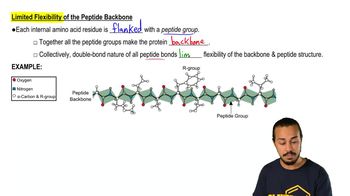
    It limits the flexibility of the protein backbone by restricting rotation at the peptide bond.
  • Which bonds in the peptide backbone can rotate?

    The bonds adjacent to the peptide bond (not the peptide bond itself) can rotate.
  • What is the result of the planarity of peptide groups for the protein backbone?

    The planarity of peptide groups means the protein backbone is made up of rigid planes connected by rotatable bonds.
  • What is the main reason the cis conformation is less favorable for most peptide groups?

    The cis conformation is less favorable due to increased steric hindrance between R groups.
  • What charges are present on the atoms in the resonance hybrid of the peptide group?

    The carbonyl oxygen has a partial negative charge, and the nitrogen has a partial positive charge.
  • How does the structure of the peptide group influence the possible structures of peptides and proteins?

    The rigidity and planarity of peptide groups limit the possible conformations and structures that peptides and proteins can adopt.