Back

Practice: Oxidative Phosphorylation 1 definitions

Control buttons has been changed to "navigation" mode.
1/15
  • Cytochrome c

    A heme-containing protein in complex III that accepts only one electron at a time during electron transport.
  • Q cycle

    A mechanism in complex III enabling efficient electron transfer when only one electron can be accepted at a time.
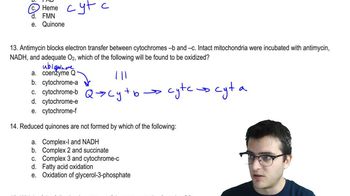
  • Antimycin

    A compound that blocks electron transfer between cytochromes b and c, disrupting mitochondrial electron transport.
  • Cytochrome b

    A protein in complex III that receives electrons from ubiquinone and passes them to cytochrome c.
  • Cytochrome A

    A component downstream in the electron transport chain that remains oxidized when electron flow is blocked.
  • Ubiquinone

    A lipid-soluble electron carrier, also known as coenzyme Q, that transfers electrons to complex III.
  • Complex III

    A segment of the electron transport chain where quinones are oxidized and cytochrome c receives electrons.
  • NADH

    A molecule that donates electrons to complex I, initiating electron flow in the mitochondrial electron transport chain.
  • Succinate

    A substrate that feeds electrons into the electron transport chain via complex II, but is not required for proton motive force.
  • Fatty acid oxidation

    A metabolic process generating FADH2, which transfers electrons to ubiquinone for entry into the electron transport chain.
  • Glycerol 3-phosphate

    A molecule involved in a shuttle system that helps transfer electrons from cytosolic NADH into mitochondria.
  • Malate aspartate shuttle

    A pathway that moves electrons from cytosolic NADH into mitochondria, enabling entry at complex I.
  • Proton motive force

    The electrochemical gradient generated by electron transport, driving ATP synthesis in mitochondria.
  • Complex I

    The first protein complex in the electron transport chain, accepting electrons from NADH and reducing quinones.
  • Complex II

    A protein complex that receives electrons from succinate and reduces quinones, contributing to electron transport.