Back

Practice: Oxidative Phosphorylation 1 quiz

Control buttons has been changed to "navigation" mode.
1/15
  • Which component of the electron transport chain can only accept one electron at a time?

    Cytochrome c in complex III can only accept one electron at a time.
  • What is the purpose of the Q cycle in complex III?

    The Q cycle allows for efficient electron transport because cytochrome c can only accept one electron at a time.
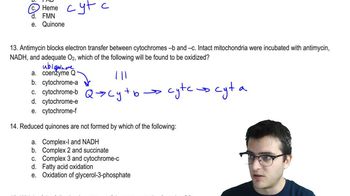
  • What does antimycin inhibit in the electron transport chain?

    Antimycin blocks electron transfer between cytochromes b and c in complex III.
  • If mitochondria are treated with antimycin, which cytochrome remains oxidized?

    Cytochrome A remains oxidized because electron transfer is blocked.
  • Where are reduced quinones not formed during electron transport?

    Reduced quinones are not formed in complex III or by cytochrome c.
  • Which complexes or processes lead to the reduction of quinones?

    Complex I, complex II, fatty acid oxidation, and glycerol 3-phosphate oxidation lead to the reduction of quinones.
  • What is another name for coenzyme Q?

    Coenzyme Q is also known as ubiquinone.
  • How do electrons from fatty acid oxidation enter the electron transport chain?

    Fatty acid oxidation generates FADH2, which passes electrons to ubiquinone.
  • What is the role of glycerol 3-phosphate in electron transport?

    Glycerol 3-phosphate oxidation helps transfer electrons from cytosolic NADH into the mitochondria via FADH2 and ubiquinone.
  • Does the generation of the proton motive force require succinate?

    No, the proton motive force does not specifically require succinate; electrons can enter the chain through multiple pathways.
  • Which enzyme allows succinate to feed electrons into the electron transport chain?

    Succinate dehydrogenase, also known as complex II, allows succinate to feed electrons into the chain.
  • What is the function of the malate-aspartate shuttle?

    The malate-aspartate shuttle transfers electrons from cytosolic NADH into the mitochondria to enter the electron transport chain.
  • What happens to ubiquinone at complex III?

    Ubiquinone is oxidized at complex III as it donates electrons to the chain.
  • Which cytochrome receives electrons directly from cytochrome c?

    Cytochrome A receives electrons directly from cytochrome c.
  • Why is it incorrect to say that only succinate is required for the proton motive force?

    It is incorrect because electrons can enter the electron transport chain through several pathways, not just via succinate.