Back

Practice: Oxidative Phosphorylation 2 quiz

Control buttons has been changed to "navigation" mode.
1/15
  • What is the result of electron transport through the inner mitochondrial membrane?

    It results in the release of protons into the intermembrane space, creating a proton gradient.
  • How does the proton motive force drive ATP synthesis?

    It causes conformational changes in ATP synthase, enabling the synthesis of ATP from ADP.
  • Which part of ATP synthase spins to induce conformational changes in the F1 portion?

    The F0 portion spins, causing the gamma subunit of the F1 portion to rotate and induce conformational changes.
  • What is the role of the beta subunits in ATP synthase?

    Conformational changes in the beta subunits lead to the formation and release of ATP.
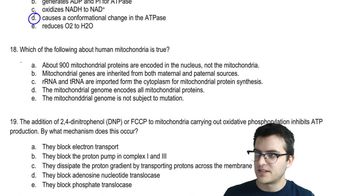
  • Where are most mitochondrial proteins encoded in humans?

    About 900 out of 1000 mitochondrial proteins are encoded in the nucleus, not the mitochondria.
  • How is mitochondrial DNA inherited in humans?

    Mitochondrial DNA is inherited exclusively from the mother, a form of non-Mendelian inheritance.
  • What materials for protein synthesis do mitochondria provide themselves?

    Mitochondria make their own ribosomes and transfer RNA (tRNA).
  • Do mitochondrial genomes encode all mitochondrial proteins?

    No, mitochondrial genomes do not encode all mitochondrial proteins.
  • Are mitochondrial genes subject to mutation?

    Yes, mitochondrial genes are subject to mutation.
  • What effect do uncoupling agents like DNP and FCCP have on mitochondria?

    They inhibit ATP production by dissipating the proton gradient across the inner mitochondrial membrane.
  • How do uncouplers like FCCP dissipate the proton gradient?

    They transport protons across the membrane, eliminating the gradient needed for ATP synthesis.
  • What happens to the phosphate-to-oxygen (P/O) ratio after adding uncouplers?

    The P/O ratio decreases because less ATP (phosphate) is produced per oxygen consumed.
  • Does electron transport stop when uncouplers are added?

    No, electron transport and oxygen consumption continue even when uncouplers are present.
  • Why does ATP synthase fail to function properly in the presence of uncouplers?

    Because the proton motive force is dissipated, ATP synthase cannot synthesize ATP efficiently.
  • What does a decrease in the P/O ratio indicate about mitochondrial function?

    It indicates that ATP synthesis is less efficient relative to oxygen consumption, due to uncoupling.