Back

Reaction Rate quiz

Control buttons has been changed to "navigation" mode.
1/15
  • What is another name for reaction rate in biochemistry?

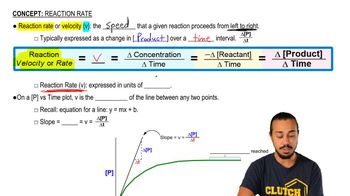
    Reaction rate is also known as reaction velocity.
  • How is reaction velocity symbolized in equations?

    Reaction velocity is symbolized with the lowercase letter 'v'.
  • What is the formula for reaction velocity?

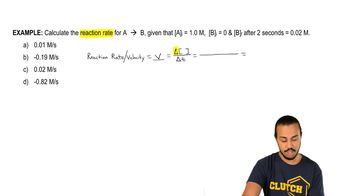
    Reaction velocity is calculated as the change in concentration of products divided by the change in time.
  • What units are typically used to express reaction velocity?

    Reaction velocity is usually expressed in molarity per second.
  • On a graph plotting product concentration versus time, what does the slope represent?

    The slope of the line represents the reaction velocity.
  • How do you calculate the slope on a product concentration vs. time graph?

    The slope is calculated as the rise (change in product concentration) over the run (change in time).
  • Why is a negative sign used when calculating reaction velocity from reactant concentration?

    A negative sign is used because reactant concentration decreases over time during the reaction.
  • Which concentration do biochemists typically focus on when calculating reaction velocity?

    Biochemists typically focus on the change in product concentration.
  • What happens to the reaction rate of enzyme-catalyzed reactions over time?

    The reaction rate generally decreases over time.
  • What does it mean when the slope of the product concentration vs. time graph reaches zero?

    It means that equilibrium has been reached in the reaction.
  • Do enzymes change the equilibrium of a reaction?

    No, enzymes do not change the equilibrium; they only speed up the reaction to reach equilibrium faster.
  • What is the standard equation for a line used to describe the relationship in these graphs?

    The standard equation is y = mx + b, where m is the slope.
  • What does the 'rise' in the slope calculation refer to in this context?

    The 'rise' refers to the change in product concentration on the y-axis.
  • What does the 'run' in the slope calculation refer to in this context?

    The 'run' refers to the change in time on the x-axis.
  • Why does the curve level off in a product concentration vs. time graph for enzyme-catalyzed reactions?

    The curve levels off because equilibrium has been reached and the reaction rate becomes zero.