Back

Salting Out quiz

Control buttons has been changed to "navigation" mode.
1/15
  • What is the main purpose of salting out in protein purification?

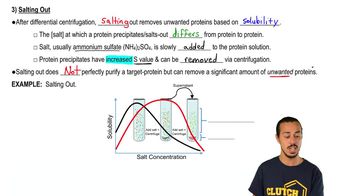
    Salting out is used to selectively precipitate proteins based on their solubility differences, helping to remove unwanted proteins and increase the purity of the target protein.
  • Which salt is most commonly used in the salting out process?

    Ammonium sulfate is most commonly used because it is effective at precipitating proteins during salting out.
  • What happens to protein solubility as salt concentration increases from low to medium levels?

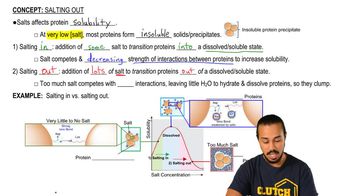
    Protein solubility increases as salt concentration rises from low to medium, allowing proteins to dissolve ('salting in').
  • Why do proteins precipitate at very low salt concentrations?

    At low salt concentrations, strong interactions between polar charged amino acids on protein surfaces cause proteins to clump and form insoluble precipitates.
  • What is the mechanism behind 'salting in'?

    Salting in occurs when added salt weakens the interactions between proteins, increasing their solubility and allowing them to dissolve.
  • How does high salt concentration lead to 'salting out'?

    High salt concentration reduces the amount of water available to hydrate proteins, causing them to precipitate out of solution.
  • How do biochemists exploit protein solubility differences during salting out?

    They add salt gradually to selectively precipitate proteins at different concentrations, separating them based on their solubility curves.
  • What role does centrifugation play in salting out?

    Centrifugation is used to sediment and collect precipitated proteins as pellets at the bottom of the container.
  • What happens to the sedimentation coefficient (s value) of proteins during salting out?

    The s value increases for precipitated proteins, causing them to sediment faster during centrifugation.
  • Is salting out a complete protein purification method?

    No, salting out is not a complete purification method and must be combined with other techniques for higher purity.
  • What is the difference between the pellet and the supernatant after centrifugation in salting out?

    The pellet contains precipitated proteins, while the supernatant contains proteins that remain dissolved at that salt concentration.
  • How can you isolate a target protein using salting out and centrifugation?

    By adjusting salt concentration to selectively precipitate the target protein, then collecting it from the pellet or supernatant after centrifugation.
  • What is the effect of adding too much salt to a protein solution?

    Adding too much salt causes proteins to lose hydration and precipitate, decreasing their solubility ('salting out').
  • Why do different proteins precipitate at different salt concentrations?

    Because each protein has a unique solubility curve, so their precipitation points vary with salt concentration.
  • What is the main takeaway regarding salt concentration and protein solubility?

    Protein solubility is highly dependent on salt concentration, with optimal levels needed for dissolution and higher levels causing precipitation.