Back

SDS-PAGE Strategies definitions

Control buttons has been changed to "navigation" mode.
1/15
  • SDS-PAGE

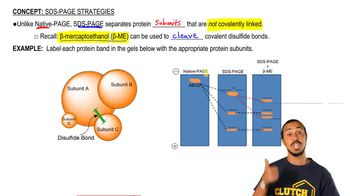
    Technique that separates denatured proteins based solely on mass, enabling analysis of subunit composition and size.
  • Native PAGE

    Method that preserves protein shape, charge, and mass, keeping complexes intact during migration.
  • Protein Subunit

    Individual polypeptide component within a larger protein complex, which may be linked by covalent or non-covalent interactions.
  • Disulfide Bond

    Covalent linkage between two cysteine residues, stabilizing protein structure and connecting subunits.
  • Beta-Mercaptoethanol

    Reducing agent used to cleave covalent disulfide bonds, allowing separation of previously linked protein subunits.
  • Sodium Dodecylsulfate

    Negatively charged detergent that denatures proteins, imparting uniform charge for mass-based separation.
  • Quaternary Structure

    Arrangement of multiple protein subunits forming a functional complex, often stabilized by covalent and non-covalent bonds.
  • Non-Covalent Interaction

    Association between protein subunits not involving covalent bonds, such as hydrogen bonds or ionic interactions.
  • Reducing Agent

    Chemical that breaks covalent disulfide bonds, facilitating separation of protein subunits in SDS-PAGE.
  • Migration Speed

    Rate at which proteins move through a gel, inversely related to their size in SDS-PAGE.
  • Protein Band

    Visual representation of a protein or subunit on a gel, indicating its size and separation status.
  • Denaturation

    Process by which proteins lose their native structure, often induced by detergents like SDS.
  • Gel Electrophoresis

    Laboratory technique for separating biomolecules based on physical properties such as size, charge, or shape.
  • Charge

    Electrical property influencing protein migration in native PAGE, but standardized in SDS-PAGE by detergent binding.
  • Mass

    Physical property determining protein migration in SDS-PAGE, with larger proteins moving slower through the gel.