Back

SDS-PAGE quiz

Control buttons has been changed to "navigation" mode.
1/15
  • What does SDS stand for in SDS PAGE, and what is its main function?

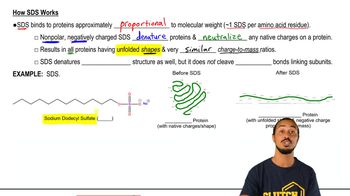
    SDS stands for Sodium Dodecyl Sulfate, and its main function is to denature proteins and impart a uniform negative charge to them.
  • How does SDS PAGE separate proteins?

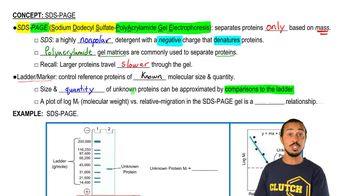
    SDS PAGE separates proteins based solely on their mass, with larger proteins migrating slower and smaller proteins migrating faster through the gel.
  • What is the role of polyacrylamide in SDS PAGE?

    Polyacrylamide forms the gel matrix that proteins migrate through during electrophoresis, allowing for effective separation based on size.
  • Why do all proteins migrate toward the bottom of the gel in SDS PAGE?

    All proteins migrate toward the bottom because SDS gives them a uniform negative charge, causing them to move toward the positive electrode at the bottom.
  • How does SDS affect the native shape and charge of proteins?

    SDS denatures proteins, unfolding them and neutralizing their native charges by overwhelming them with negative charges.
  • What is the approximate binding ratio of SDS to proteins?

    SDS binds to proteins at a ratio of about 1 SDS molecule per amino acid residue.
  • How can the size of an unknown protein be estimated using SDS PAGE?

    The size can be estimated by comparing the migration distance of the unknown protein to a ladder of proteins with known molecular weights.
  • What is the relationship between log molecular weight and relative migration in SDS PAGE?

    There is a linear relationship between the log of the molecular weight and the relative migration distance of proteins in the gel.
  • How does SDS PAGE help in visualizing protein purification?

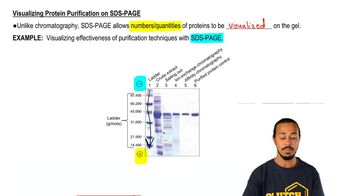
    SDS PAGE allows visualization of both the number and quantity of proteins present, showing the effectiveness of purification steps by the appearance or disappearance of bands.
  • What happens to protein subunits with quaternary structure during SDS PAGE?

    SDS denatures quaternary structure, separating subunits unless they are linked by disulfide bonds, which SDS does not cleave.
  • Why might two protein subunits appear as a single band on an SDS PAGE gel?

    If the subunits are linked by disulfide bonds, SDS will not break these bonds, causing the subunits to migrate together as one band.
  • How does the intensity or thickness of a band on an SDS PAGE gel relate to protein quantity?

    The intensity or thickness of a band indicates the quantity of that particular protein present in the sample.
  • What is the main advantage of using SDS PAGE over chromatography for protein analysis?

    SDS PAGE allows direct visualization of protein numbers and quantities, making it easier to assess purification effectiveness.
  • How does salting out affect protein purification as visualized by SDS PAGE?

    Salting out does not perfectly purify proteins, as shown by the presence of multiple bands after this step on an SDS PAGE gel.
  • What does it indicate if a protein band after affinity chromatography matches the purified protein control on SDS PAGE?

    It indicates that the protein of interest has been effectively purified, as shown by the similarity in band position and intensity.