Back

Sickle Cell Anemia quiz

Control buttons has been changed to "navigation" mode.
1/15
  • What specific mutation causes sickle cell anemia?

    A homozygous point mutation in the gene for the beta subunit of hemoglobin, changing glutamate to valine at the 6th position, causes sickle cell anemia.
  • How does the amino acid change in sickle cell anemia affect hemoglobin?

    The change from glutamate (charged) to valine (neutral) alters protein folding, leading to abnormal hemoglobin structure.
  • What is the difference between HBA and HBS hemoglobin?

    HBA is normal adult hemoglobin, while HBS is the mutated form found in sickle cell anemia.
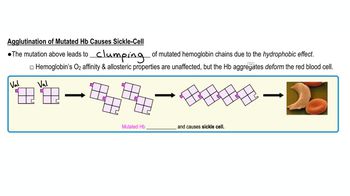
  • What is agglutination in the context of sickle cell anemia?

    Agglutination refers to the clumping of mutated hemoglobin molecules due to the hydrophobic effect of valine residues.
  • Why do sickled red blood cells form in sickle cell anemia?

    Mutated hemoglobin chains aggregate and deform red blood cells into a sickle shape.
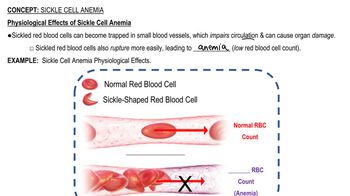
  • What is the main health consequence of sickle-shaped red blood cells?

    Sickle-shaped cells can block small blood vessels, impairing circulation and causing organ damage.
  • Why do patients with sickle cell anemia experience anemia?

    Sickled red blood cells rupture more easily, leading to a lower red blood cell count (anemia).
  • What does the term 'occlusion' mean in sickle cell anemia?

    Occlusion refers to the blockage of blood vessels by sickled red blood cells.
  • How does sickle cell anemia affect the oxygen affinity of hemoglobin?

    The oxygen affinity and allosteric properties of hemoglobin are not affected by the sickle cell mutation.
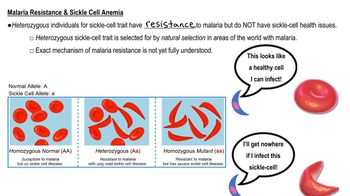
  • What is the genetic advantage of being heterozygous for the sickle cell trait?

    Heterozygous individuals are resistant to malaria without suffering from amjor sickle cell health issues.
  • Why is the sickle cell trait more common in malaria-endemic regions?

    Natural selection favors the sickle cell trait in these regions because it provides resistance to malaria.
  • What is the difference between homozygous normal, heterozygous, and homozygous mutant individuals regarding sickle cell and malaria?

    Homozygous normal individuals are susceptible to malaria, heterozygotes are resistant to malaria without severe sickle cell disease, and homozygous mutants have severe sickle cell disease but are also resistant to malaria.
  • What is the molecular basis for the clumping of hemoglobin in sickle cell anemia?

    The hydrophobic valine residues in mutated hemoglobin cause the molecules to stick together, forming long chains.
  • How does the sickle cell mutation affect the charge of the hemoglobin molecule?

    The mutation replaces negatively charged glutamate with neutral valine, changing the molecule's charge properties.
  • Why is sickle cell anemia considered an example of a genetic disease with both harmful and beneficial effects?

    While homozygous individuals suffer from severe disease, heterozygotes gain malaria resistance, which is beneficial in certain environments.