Back

Skeletal Muscle Contraction definitions

Control buttons has been changed to "navigation" mode.
1/15
  • Sarcomere

    Structural unit of muscle fiber whose length changes during contraction, with specific regions shrinking or remaining constant.
  • Sliding Filament Model

    Mechanism describing how thick and thin filaments interact to shorten muscle fibers without altering overall muscle volume.
  • H Zone

    Region within a sarcomere containing only thick filaments, which decreases in size during muscle contraction.
  • I Band

    Area of a sarcomere composed solely of thin filaments, narrowing as muscle contracts.
  • A Band

    Section of a sarcomere representing the length of thick filaments, remaining unchanged during contraction.
  • M Disc

    Central structure in the sarcomere toward which actin filaments are pulled during contraction.
  • Z Disc

    Boundary of a sarcomere anchoring actin filaments, moving closer to the center during contraction.
  • Actin

    Thin filament protein pulled toward the center of the sarcomere, enabling muscle shortening.
  • Myosin

    Thick filament protein whose head interacts with actin to drive muscle contraction through cyclic movements.
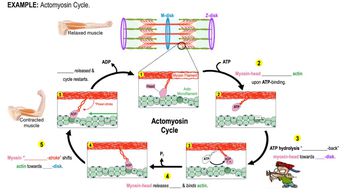
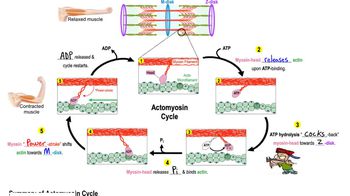
  • Actomyosin Cycle

    Five-step biochemical process involving ATP and filament interactions, resulting in sarcomere contraction.
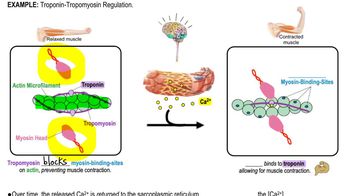
  • Troponin

    Regulatory protein binding calcium, triggering a conformational change that exposes binding sites for contraction.
  • Tropomyosin

    Long regulatory protein blocking binding sites on actin, preventing contraction until shifted by troponin.
  • Sarcoplasmic Reticulum

    Membranous organelle in muscle cells responsible for storing and releasing calcium to regulate contraction.
  • Calcium

    Ion released upon nervous stimulation, binding to troponin and enabling muscle contraction by exposing binding sites.
  • Power Stroke

    Movement of the myosin head that shifts actin toward the center of the sarcomere, driving muscle contraction.