Back

Spectrophotometry quiz

Control buttons has been changed to "navigation" mode.
1/15
  • What instrument is used by biochemists to measure light absorbance for protein quantification?

    Biochemists use spectrophotometers to measure light absorbance and quantify proteins.
  • What law relates absorbance to concentration, path length, and extinction coefficient in spectrophotometry?

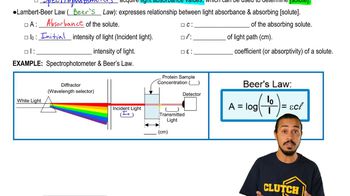
    Beer's Law (or Lambert Beer Law) relates absorbance to concentration, path length, and extinction coefficient.
  • In Beer's Law, what does the variable 'A' represent?

    'A' represents the absorbance of the solute or protein in the sample.
  • What is the incident light in spectrophotometry and how is it symbolized?

    Incident light is the initial intensity of light before it passes through the sample, symbolized as I₀.
  • What does the variable 'I' represent in Beer's Law?

    'I' represents the transmitted intensity of light after it passes through the sample.
  • How does the concentration of a protein affect its light absorbance?

    Higher protein concentration increases light absorbance because more molecules absorb more light.
  • What does the variable 'l' represent in Beer's Law and how is it measured?

    'l' represents the length of the light path through the sample, typically measured in centimeters.
  • What is the extinction coefficient and how is it symbolized in Beer's Law?

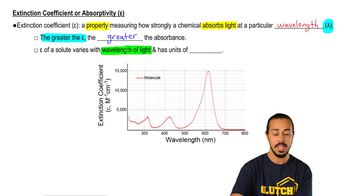
    The extinction coefficient, symbolized as ε (epsilon), measures how strongly a chemical absorbs light at a specific wavelength.
  • How does the extinction coefficient affect absorbance in Beer's Law?

    A higher extinction coefficient increases absorbance, and it varies with different wavelengths.
  • What units are used for the extinction coefficient in spectrophotometry?

    The extinction coefficient is measured in inverse molarity (M⁻¹) and inverse centimeters (cm⁻¹).
  • What does an absorbance spectrum plot on its axes?

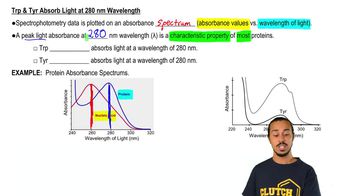
    An absorbance spectrum plots absorbance values on the y-axis and wavelength of light on the x-axis.
  • At what wavelength do proteins strongly absorb light, and which amino acids are responsible?

    Proteins strongly absorb light at 280 nm due to the amino acids tryptophan and tyrosine.
  • Why is quantifying proteins without tryptophan or tyrosine challenging using spectrophotometry?

    Other amino acids do not significantly absorb light at 280 nm, making quantification difficult if tryptophan or tyrosine are absent.
  • How does the wavelength of light affect the extinction coefficient and absorbance?

    The extinction coefficient and absorbance both vary depending on the wavelength of light used.
  • Why do biochemists commonly use 280 nm to quantify most proteins?

    Most proteins contain tryptophan and tyrosine, which absorb strongly at 280 nm, allowing accurate quantification.