Back

Steroids definitions

Control buttons has been changed to "navigation" mode.
1/15
  • Steroids

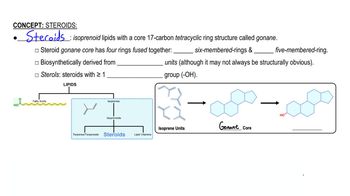
    Isoprenoid lipids with a core 17-carbon tetracyclic ring, biosynthetically derived from isoprene units and found in various biological roles.
  • Isoprenoid

    Class of lipids constructed from isoprene units, forming diverse structures such as terpenes and steroids.
  • Gonane

    Core structure of steroids, consisting of four fused rings—three six-membered and one five-membered—totaling 17 carbons.
  • Tetracyclic Ring

    Four fused cyclic rings forming the backbone of steroid molecules, providing structural rigidity and diversity.
  • Isoprene Unit

    Five-carbon building block used in biosynthesis of isoprenoid lipids, including steroids and terpenes.
  • Sterol

    Subtype of steroids containing at least one hydroxyl group attached to the gonane core, exemplified by cholesterol.
  • Hydroxyl Group

    Functional group consisting of an oxygen and hydrogen atom, often attached to steroids at specific carbon positions.
  • Cholesterol

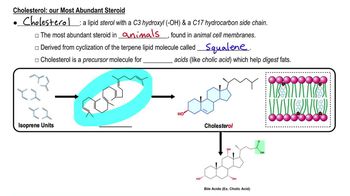
    Most abundant sterol in animal cells, featuring a C3 hydroxyl group and C17 hydrocarbon chain, crucial for membrane structure and precursor roles.
  • Squalene

    Terpene lipid composed of six isoprene units, serving as a precursor for cholesterol via cyclization.
  • Bile Acid

    Molecule derived from cholesterol, such as cholic acid, essential for fat digestion and absorption in the intestine.
  • Cholic Acid

    Prevalent bile acid synthesized from cholesterol, facilitating emulsification and breakdown of dietary fats.
  • Cell Membrane

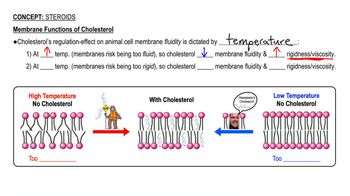
    Biological barrier in animal cells where cholesterol modulates fluidity and permeability, adapting to temperature changes.
  • Fluidity

    Property of cell membranes influenced by cholesterol, determining how freely lipid molecules move within the bilayer.
  • Permeability

    Ability of cell membranes to allow substances to cross, regulated by cholesterol to maintain optimal cellular conditions.
  • Viscosity

    Measure of membrane rigidity, increased by cholesterol at high temperatures and decreased at low temperatures to balance fluidity.