Back

Strategy for Ordering Cleaved Fragments quiz

Control buttons has been changed to "navigation" mode.
1/15
  • What is the first step in the 5-step strategy for ordering cleaved fragments?

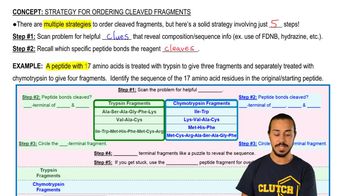
    The first step is to scan the problem for helpful clues about the protein's composition or sequence.
  • Which peptide bonds does trypsin recognize for cleavage?

    Trypsin cleaves the C-terminal peptide bonds of lysine and arginine residues.
  • Which amino acids does chymotrypsin preferentially cleave?

    Chymotrypsin preferentially cleaves the C-terminal peptide bonds of aromatic residues: phenylalanine, tyrosine, and tryptophan.
  • How can you identify a terminal peptide fragment after cleavage?

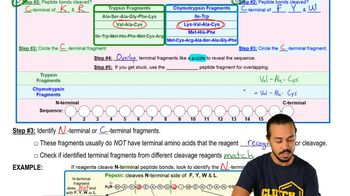
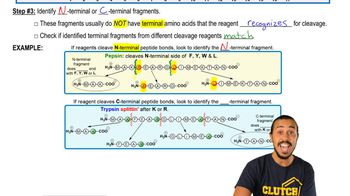
    A terminal peptide fragment does not have terminal amino acid residues that the cleavage reagent recognizes for cleavage.
  • What is the purpose of overlapping fragments from different cleavage techniques?

    Overlapping fragments from different cleavage techniques helps reconstruct the sequence of the original peptide.
  • What should you do if you get stuck while ordering fragments?

    If you get stuck, use the longest peptide fragment as a starting point for overlapping with other fragments.
  • Why is it important to check if terminal fragments from different reagents match?

    Matching terminal fragments from different reagents confirms that you are ordering the fragments correctly.
  • What does pepsin cleave, and how does this help identify the N-terminal fragment?

    Pepsin cleaves the N-terminal peptide bonds of phenylalanine, tyrosine, tryptophan, and leucine; the N-terminal fragment lacks these residues at its end.
  • How do you identify the C-terminal fragment after trypsin cleavage?

    The C-terminal fragment is the only one that does not end with lysine or arginine, which are recognized by trypsin.
  • What is the main goal of the 5-step strategy for ordering cleaved fragments?

    The main goal is to reconstruct the sequence of the original peptide by systematically overlapping fragments.
  • What information should you collect in step 1 if available?

    Collect clues such as the use of chemicals (e.g., FDNB, hydrazine) or the total number of amino acids in the peptide.
  • What mnemonic helps remember chymotrypsin’s preferred cleavage sites?

    The mnemonic 'free your worries like me' helps recall that chymotrypsin prefers phenylalanine, tyrosine, and tryptophan.
  • What do you do if there is a tie for the longest peptide fragment in step 5?

    Pick any of the longest fragments and continue overlapping with other fragments until the sequence is revealed.
  • How do you confirm that all fragments have been correctly overlapped?

    All fragments are correctly overlapped when you can read the complete sequence from N-terminal to C-terminal without any residues left unmatched.
  • Why might step 5 not be necessary in every problem?

    Step 5 is only needed if you get stuck; if you can overlap all fragments without difficulty, you can skip it.