Back

Summary of Biosignaling definitions

Control buttons has been changed to "navigation" mode.
1/16
  • GPCR

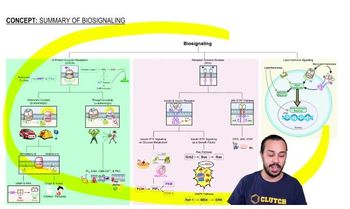
    A membrane receptor with seven transmembrane alpha helices, couples with heterotrimeric G proteins to initiate cellular responses.
  • Heterotrimeric G Protein

    A protein complex with alpha, beta, and gamma subunits, mediates signal transduction from GPCRs.
  • Adenylate Cyclase

    An effector enzyme activated by stimulatory G proteins, produces cAMP as a secondary messenger.
  • cAMP

    A secondary messenger generated by adenylate cyclase, allosterically activates protein kinase A.
  • Protein Kinase A

    A kinase activated by cAMP, consists of regulatory and catalytic subunits, triggers cellular responses.
  • Phospholipase C

    An effector enzyme in the phosphoinositide pathway, cleaves PIP2 to produce DAG and IP3.
  • DAG

    A secondary messenger produced from PIP2 cleavage, activates protein kinase C with calcium.
  • IP3

    A secondary messenger from PIP2 cleavage, stimulates calcium release from the endoplasmic reticulum.
  • Calmodulin

    A calcium-binding protein that activates cytosolic protein kinases upon calcium association.
  • Receptor Tyrosine Kinase

    A membrane receptor with tyrosine kinase domains, phosphorylates tyrosine residues to initiate signaling.
  • IRS1

    A phosphorylated substrate in insulin signaling, acts as a branch point for downstream pathways.
  • PI3K

    A kinase in insulin signaling, promotes glycogen synthesis and GLUT4 expression.
  • RAS

    A monomeric G protein involved in growth factor signaling, initiates the MAPK pathway.
  • MAPK

    A kinase cascade including RAF, MEK, and ERK, mediates growth factor responses.
  • JAK-STAT Pathway

    A signaling route where a cytosolic tyrosine kinase and transcription factors are recruited for gene expression.
  • Lipid Hormone

    A hydrophobic molecule capable of diffusing through plasma membranes, directly affects metabolism and gene expression.