Back

Summary of Biosignaling quiz

Control buttons has been changed to "navigation" mode.
1/15
  • What are the three main types of biosignaling pathways discussed in the summary?

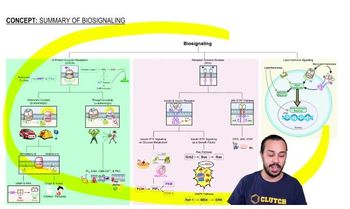
    The three main types are GPCRs (G protein-coupled receptors), RTKs (receptor tyrosine kinases), and lipid hormone pathways.
  • How many transmembrane alpha helices are found in GPCRs?

    GPCRs have 7 transmembrane alpha helices.
  • What are the three subunits of the heterotrimeric G protein associated with GPCRs?

    The three subunits are alpha, beta, and gamma.
  • Which secondary messenger is produced in the adenylate cyclase GPCR pathway?

    The secondary messenger produced is cAMP (cyclic AMP).
  • What enzyme does cAMP activate in the adenylate cyclase pathway?

    cAMP activates protein kinase A (PKA).
  • What are the two secondary messengers generated in the phosphoinositide GPCR pathway?

    The two secondary messengers are DAG (diacylglycerol) and IP3 (inositol trisphosphate).
  • What is the role of IP3 in the phosphoinositide pathway?

    IP3 stimulates the release of calcium from the endoplasmic reticulum.
  • Which enzyme is activated by DAG and calcium in the phosphoinositide pathway?

    Protein kinase C (PKC) is activated by DAG and calcium.
  • What is the main function of receptor tyrosine kinases (RTKs)?

    RTKs phosphorylate tyrosine residues on target proteins.
  • What is the role of IRS1 in insulin RTK signaling?

    IRS1 acts as a branch point leading to pathways for glucose metabolism and growth factor signaling.
  • Which pathway involves the proteins GRB2, SOS, and RAS?

    These proteins are involved in the RAS pathway, part of the insulin RTK growth factor signaling.
  • What distinguishes the JAK-STAT pathway from other RTK pathways?

    The JAK-STAT pathway recruits a separate cytosolic tyrosine kinase (JAK) and transcription factors (STAT), rather than having a covalently bound kinase domain.
  • What is the main characteristic of lipid hormone signaling?

    Lipid hormones can diffuse directly through plasma membranes due to their hydrophobic nature.
  • What cellular responses can lipid hormones directly affect?

    Lipid hormones can directly affect metabolic responses and gene expression.
  • What diseases are associated with cholera and pertussis toxins affecting GPCR signaling?

    Cholera toxin overstimulates the stimulatory G protein (GS), causing cholera, while pertussis toxin inhibits the inhibitory G protein (GI), causing whooping cough.