Skip to main content
Biochemistry
My Course
Learn
Exam Prep
AI Tutor
Study Guides
Flashcards
Explore
Try the app
My Course
Learn
Exam Prep
AI Tutor
Study Guides
Flashcards
Explore
Try the app
Back
Buffer Solution definitions
You can tap to flip the card.
Buffer
You can tap to flip the card.
👆
Buffer
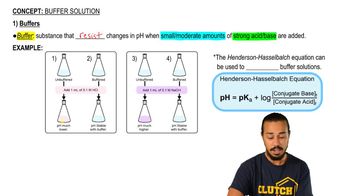
Substance that maintains stable pH when small amounts of strong acids or bases are added, crucial for biochemical processes.
Track progress
Control buttons has been changed to "navigation" mode.
1/15
Related flashcards
Related practice
Recommended videos
Buffer Solution quiz #1
Buffer Solution
10 Terms
Buffer Solution
2. Water
7 problems
Topic
Titration
2. Water
7 problems
Topic
2. Water - Part 1 of 3
4 topics
11 problems
Chapter
2. Water - Part 2 of 3
5 topics
11 problems
Chapter
2. Water - Part 3 of 3
4 topics
11 problems
Chapter
Guided course
02:48
Effective Buffer Ranges
1589
views
7
rank
1
comments
Guided course
03:31
Buffers
2025
views
13
rank
1
comments
Guided course
03:39
Biological Buffers
1479
views
11
rank
Terms in this set (15)
Hide definitions
Buffer
Substance that maintains stable pH when small amounts of strong acids or bases are added, crucial for biochemical processes.
pH
Measure of hydrogen ion concentration, indicating acidity or basicity; stability is essential for enzyme activity.
Henderson-Hasselbalch Equation
Mathematical expression relating pH, pKa, and ratio of conjugate base to acid, used to prepare buffer solutions.
pKa
Value representing the acid dissociation constant; central to determining effective buffering range of weak acids.
Conjugate Base
Species formed when a weak acid loses a proton; pairs with its acid to create an effective buffer system.
Conjugate Acid
Species formed when a base gains a proton; partners with its base in buffer systems to resist pH changes.
Acetic Acid
Monoprotic weak acid with formula CH3COOH; effective buffer within pH range 3.8 to 5.8 due to its pKa of 4.8.
Titration Curve
Graph showing pH changes as titrant is added; inflection point indicates pKa and effective buffering range.
Phosphate Buffer System
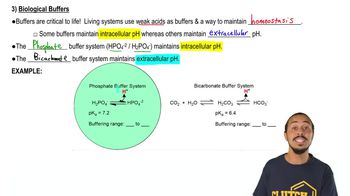
Intracellular buffer using dihydrogen phosphate and hydrogen phosphate; effective near pKa of 7.2.
Bicarbonate Buffer System
Extracellular buffer composed of carbonic acid and bicarbonate; maintains blood pH near 7.4.
Dihydrogen Phosphate
Component of phosphate buffer system; helps maintain intracellular pH within effective buffering range.
Hydrogen Phosphate
Partner in phosphate buffer system; works with dihydrogen phosphate to stabilize cell pH.
Carbonic Acid
Weak acid in bicarbonate buffer system; pKa of 6.4, crucial for maintaining extracellular pH.
Bicarbonate
Conjugate base in bicarbonate buffer system; interacts with carbonic acid to regulate blood pH.
Homeostasis
Biological state where internal conditions, such as pH, are maintained for optimal enzyme and cellular function.
 BackBack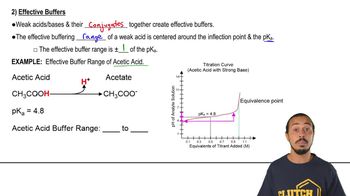
 02:48
02:48