Pearson+ LogoPearson+ Logo
Ch. 1 - Biology: The Study of Life
Freeman - Biological Science 7th Edition
Freeman7th EditionBiological ScienceISBN: 9783584863285Not the one you use?Change textbook
Chapter 1, Problem 8

Explain why researchers formulate a null hypothesis in addition to a hypothesis when designing an experimental study.

Verified step by step guidance
1
Begin by understanding the purpose of a hypothesis in scientific research. A hypothesis is a testable statement that predicts the outcome of an experiment based on prior knowledge or observations.
Recognize the role of a null hypothesis. The null hypothesis is a statement that there is no effect or no difference, and it serves as a default position that researchers aim to test against their main hypothesis.
Consider the importance of the null hypothesis in statistical testing. It provides a basis for comparison, allowing researchers to determine if the observed data significantly deviates from what would be expected under the null hypothesis.
Understand how the null hypothesis helps in avoiding bias. By formulating a null hypothesis, researchers ensure that they are not only looking for evidence that supports their hypothesis but also considering the possibility that their hypothesis might not be correct.
Appreciate the role of the null hypothesis in scientific rigor. It helps in establishing a clear framework for testing and analyzing data, ensuring that conclusions drawn from the experiment are based on objective evidence rather than subjective expectations.

Verified video answer for a similar problem:

This video solution was recommended by our tutors as helpful for the problem above.
Video duration:
3m
Was this helpful?

Key Concepts

Here are the essential concepts you must grasp in order to answer the question correctly.

Hypothesis

A hypothesis is a testable statement that predicts a possible outcome or relationship between variables in an experiment. It is based on prior knowledge, observations, and logical reasoning. Formulating a hypothesis helps guide the experimental design and provides a focus for data collection and analysis.
Recommended video:
Guided course
08:22
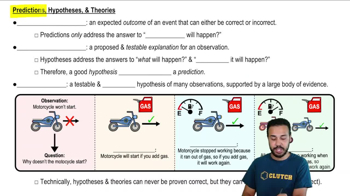
Predictions, Hypotheses, & Theories

Null Hypothesis

The null hypothesis is a statement that assumes no effect or no difference between groups or variables in an experiment. It serves as a default position that researchers aim to test against the alternative hypothesis. By attempting to reject the null hypothesis, researchers can provide evidence supporting the presence of an effect or relationship.
Recommended video:
Guided course
08:22
Predictions, Hypotheses, & Theories

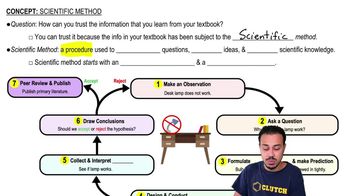
Scientific Method

The scientific method is a systematic approach to inquiry that involves making observations, forming hypotheses, conducting experiments, and analyzing results. It emphasizes the importance of objectivity and repeatability. Formulating both a hypothesis and a null hypothesis is a critical part of this process, ensuring that experiments are designed to rigorously test predictions and validate findings.
Recommended video:
Guided course
06:29
Scientific Method