Suppose that a mutant plant is unable to make methyl salicylate. Explain why it is not likely to survive in the wild.
Verified step by step guidance
1
Step 1: Understand the role of methyl salicylate in plants. Methyl salicylate is a type of phenolic compound that is produced by many plants. It serves several functions, including attracting beneficial insects, repelling harmful insects, and communicating with other plants.
Step 2: Consider the consequences of a plant not being able to produce methyl salicylate. Without this compound, the plant would be more susceptible to insect damage and disease, as it would not be able to attract beneficial insects or repel harmful ones.
Step 3: Think about the plant's ability to communicate with other plants. Methyl salicylate is involved in plant-to-plant communication, particularly in response to stress. If a plant is unable to produce this compound, it may not be able to signal to other plants that it is under stress, which could affect the overall health of the plant community.
Step 4: Reflect on the plant's survival in the wild. In the wild, plants face many challenges, including competition for resources, predation by insects, and disease. Without the ability to produce methyl salicylate, a plant would be at a significant disadvantage in dealing with these challenges.
Step 5: Conclude that a mutant plant that is unable to produce methyl salicylate is not likely to survive in the wild. This is because it would be more susceptible to insect damage and disease, less able to communicate with other plants, and less able to compete for resources.
Verified video answer for a similar problem:
This video solution was recommended by our tutors as helpful for the problem above
Video duration:
57s
Play a video:
Was this helpful?
Key Concepts
Here are the essential concepts you must grasp in order to answer the question correctly.
Methyl Salicylate
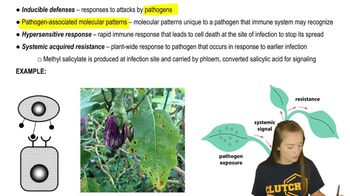
Methyl salicylate is a volatile organic compound produced by many plants, particularly in response to stress or injury. It plays a crucial role in plant defense by acting as a signaling molecule that can trigger systemic acquired resistance, helping plants to fend off pathogens and herbivores.
Plants have evolved various defense mechanisms to protect themselves from biotic stressors like pests and diseases. These mechanisms include physical barriers, chemical defenses, and signaling pathways that activate protective responses, such as the production of secondary metabolites like methyl salicylate.
Survival in the wild depends on a plant's ability to adapt to environmental challenges, including herbivory and disease. A plant that cannot produce essential defense compounds like methyl salicylate may be more susceptible to attacks, leading to reduced fitness, lower reproductive success, and ultimately, a decreased chance of survival in competitive ecosystems.