
Which of the following is a type of defense used by plants to deter herbivores? a. Chemicals toxic to the herbivore b. Chemicals that recruit other animals c. Spines d. a, b, and c
Verified step by step guidance
1
Understand the problem: The question asks about the types of defenses plants use to deter herbivores. Herbivory is when animals feed on plants, and plants have evolved various strategies to protect themselves.
Step 1: Recognize that plants can produce chemicals toxic to herbivores. These chemicals, such as alkaloids, tannins, or cyanogenic glycosides, can harm or deter herbivores from feeding on the plant.
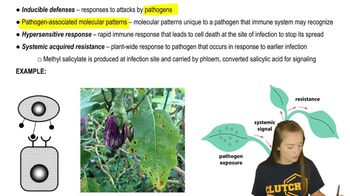
Step 2: Note that plants can also produce chemicals that attract other animals, such as predators or parasitoids, to attack the herbivores. For example, volatile organic compounds (VOCs) released by plants can signal predators to come and feed on the herbivores.
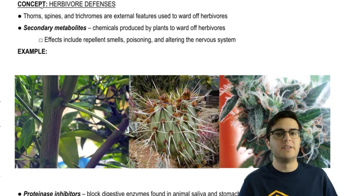
Step 3: Understand that physical defenses, such as spines or thorns, are another strategy plants use to deter herbivores by making it physically difficult or painful for them to feed on the plant.
Step 4: Combine the information: Since the question includes options a, b, and c, and all of these are valid plant defense mechanisms, the correct answer would include all three types of defenses.
Verified video answer for a similar problem:
This video solution was recommended by our tutors as helpful for the problem above
Video duration:
1m
Play a video:
Was this helpful?
Key Concepts
Here are the essential concepts you must grasp in order to answer the question correctly.
Chemical Defenses
Plants often produce secondary metabolites that are toxic or deterrent to herbivores. These chemicals can disrupt the herbivore's metabolism or deter feeding through unpleasant tastes or odors. Examples include alkaloids, tannins, and terpenoids, which serve as a direct defense mechanism against herbivory.
Some plants employ indirect defenses by releasing volatile organic compounds that attract natural predators or parasitoids of herbivores. This strategy not only reduces herbivore damage but also enhances the plant's survival by enlisting help from other species, creating a complex ecological interaction.
Physical defenses include structural adaptations such as thorns, spines, and tough leaves that make it difficult for herbivores to consume the plant. These features can physically deter herbivores or reduce the likelihood of damage, serving as a protective barrier against feeding.