How can natural disasters have positive effects on an ecosystem according to the intermediate disturbance hypothesis?
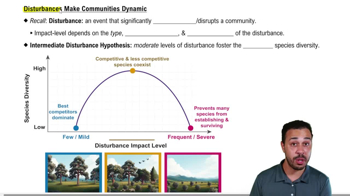
Natural disasters, as disturbances, can have positive effects on an ecosystem by creating new opportunities for different species and increasing species diversity. According to the intermediate disturbance hypothesis, moderate disturbances allow both competitive and less competitive species to coexist, fostering the highest species diversity in a community.
What is considered an extreme disturbance to an ecosystem, and how does it affect species diversity?
An extreme disturbance to an ecosystem is a highly frequent or intense event, such as a major natural disaster (e.g., volcanic eruption, forest fire, or glacier retreat), that significantly disrupts community structure and function. Extreme disturbances typically reduce species diversity by preventing many species from establishing and allowing only the best-adapted species to survive.
What factors determine the impact level of a disturbance in a community?
The impact level of a disturbance is determined by its type, frequency, and intensity. Frequency and intensity are especially important in shaping community dynamics.
Why do low disturbance impact levels result in low species diversity within a community?
Low disturbance impact levels allow the best competitors to dominate, excluding weaker competitors through the competitive exclusion principle. This leads to low species diversity.
What is the climax community in ecological succession, and how does it change over time?
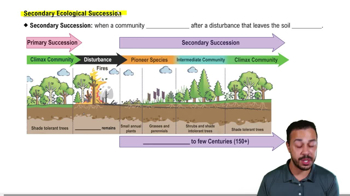
The climax community is the final and most stable stage of ecological succession. Although it is stable, ecological succession continues at a much slower rate.
How do pioneer species contribute to soil formation during primary succession?
Pioneer species, such as mosses and lichens, help break down bare rock and initiate soil formation. Their activities, along with weathering, gradually create conditions for other species to colonize.
Why does secondary succession occur more rapidly than primary succession?
Secondary succession occurs more rapidly because the soil remains intact after a disturbance, eliminating the slow process of soil formation. This allows a broader range of species to colonize the area quickly.
What types of species can serve as pioneer species in secondary succession?
In secondary succession, pioneer species can include small annual plants, grasses, and perennials. The presence of soil allows more species to act as pioneers compared to primary succession.
What are the three ways early arriving species can affect late arriving species during ecological succession?
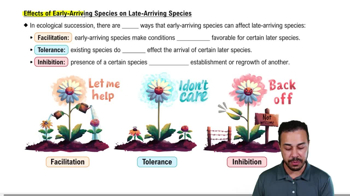
Early arriving species can affect late arriving species through facilitation, tolerance, or inhibition. Facilitation promotes, tolerance has no effect, and inhibition prevents the establishment of later species.
How does facilitation by early arriving species influence community structure during succession?
Facilitation occurs when early arriving species make conditions more favorable for certain later species. This can promote the arrival and establishment of new species, increasing community diversity.