Skip to main content
General Biology
My Course
Learn
Exam Prep
AI Tutor
Study Guides
Textbook Solutions
Flashcards
Explore
Try the app
My Course
Learn
Exam Prep
AI Tutor
Study Guides
Textbook Solutions
Flashcards
Explore
Try the app
Back
Natural Selection definitions
You can tap to flip the card.
Natural Selection
You can tap to flip the card.
👆
Natural Selection
A process where certain inherited traits become more common in a population due to increased survival and reproduction.
Track progress
Control buttons has been changed to "navigation" mode.
1/15
Related flashcards
Related practice
Recommended videos
Natural Selection exam
Natural Selection
29 Terms
Natural Selection quiz #1
Natural Selection
10 Terms
Natural Selection
21. Evolution
5 problems
Topic
Evidence of Natural Selection
21. Evolution
5 problems
Topic
21. Evolution by Natural Selection - Part 1 of 2
4 topics
9 problems
Chapter
Jason
21. Evolution - Part 2 of 2
2 topics
5 problems
Chapter
Guided course
05:11
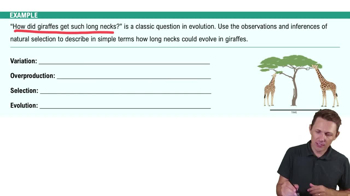
Natural Selection Example 2
3455
views
24
rank
Guided course
04:12
Natural Selection: Observations and Inferences
4462
views
46
rank
1
comments
Guided course
02:19
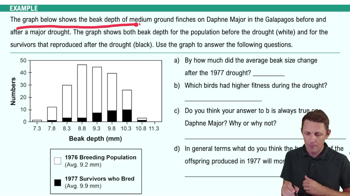
Natural Selection Example 1
3546
views
28
rank
1
comments
Terms in this set (15)
Hide definitions
Natural Selection
A process where certain inherited traits become more common in a population due to increased survival and reproduction.
Variation
Differences in traits among individuals within a population, often inherited from parents.
Adaptation
A trait that increases an organism's chance of survival and reproduction in a specific environment.
Population
A group of individuals of the same species living in the same area, subject to evolutionary changes.
Fitness
The relative likelihood of an organism passing its genes to the next generation compared to others.
Overproduction
The tendency of species to produce more offspring than the environment can support, leading to competition.
Genetic Variation
Heritable differences in DNA among individuals, forming the basis for selection.
Competition
The struggle among members of a species for limited resources, influencing which traits are passed on.
Trait Frequency
The proportion of individuals in a population that possess a specific characteristic.
Camouflage
A physical characteristic that allows organisms to blend into their environment, reducing predation risk.
Mortality
The rate at which individuals in a population die, often influenced by environmental factors and traits.
Evolution
A change in the genetic makeup of a population over generations, often driven by selection.
Environment
The external conditions and factors that influence which traits are advantageous in a population.
Offspring
The descendants produced by organisms, inheriting traits from their parents.
Adaptations
Accumulated traits in a population that enhance survival and reproductive success in a given environment.
 BackBack
 05:11
05:11