Skip to main content
General Biology
My Course
Learn
Exam Prep
AI Tutor
Study Guides
Textbook Solutions
Flashcards
Explore
Try the app
My Course
Learn
Exam Prep
AI Tutor
Study Guides
Textbook Solutions
Flashcards
Explore
Try the app
Back
Prokaryotes in the Environment definitions
You can tap to flip the card.
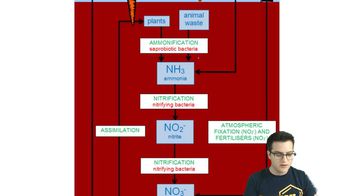
Nitrogen Cycle
You can tap to flip the card.
👆
Nitrogen Cycle
A global process where atmospheric N2 is converted into usable nitrogen forms, primarily driven by prokaryotes.
Track progress
Control buttons has been changed to "navigation" mode.
1/15
Related flashcards
Related practice
Recommended videos
Prokaryotes in the Environment quiz #2
Prokaryotes in the Environment
14 Terms
Prokaryotes in the Environment
26. Prokaryotes
5 problems
Topic
Prokaryote Lineages
26. Prokaryotes
6 problems
Topic
Jason
26. Prokaryotes - Part 1 of 2
5 topics
13 problems
Chapter
Jason
26. Prokaryotes - Part 2 of 2
2 topics
5 problems
Chapter
05:34
Prokaryote Ecology
3571
views
16
rank
03:25
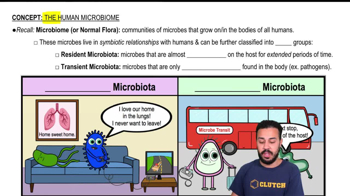
The Human Microbiome
1616
views
8
rank
03:40
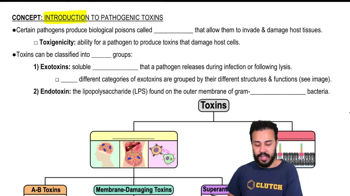
Introduction to Pathogenic Toxins
1755
views
8
rank
Terms in this set (15)
Hide definitions
Nitrogen Cycle
A global process where atmospheric N2 is converted into usable nitrogen forms, primarily driven by prokaryotes.
Nitrogen Fixation
A process performed by certain prokaryotes to convert atmospheric N2 into ammonium, essential for plant and animal nutrition.
Carbon Cycle
A biosphere-wide flow of carbon, with prokaryotes acting as decomposers to recycle organic matter.
Decomposer
An organism, often a prokaryote, that breaks down organic material, facilitating nutrient cycling.
Cyanobacteria
Photosynthetic bacteria responsible for producing much of Earth's atmospheric oxygen in ancient times.
Microbiome
The community of microbes living on and within the human body, influencing health and physiology.
Normal Flora
Microbial populations consistently present on or in the human body, often providing beneficial effects.
Resident Microbiota
Microbes that inhabit the host for extended periods, forming stable, long-term communities.
Transient Microbiota
Microbes present on the host temporarily, often for short durations before leaving or being removed.
Pathogen
A microorganism capable of causing disease, often through toxin production or tissue invasion.
Toxin
A biological poison produced by pathogens, damaging host tissues and aiding infection.
Exotoxin
A soluble protein released by pathogens during infection or lysis, with diverse structures and functions.
Endotoxin
A lipopolysaccharide component of gram-negative bacterial outer membranes, triggering host immune responses.
Virulence
The degree to which an organism can cause disease, reflecting its pathogenic potential.
Virulence Factor
A specific trait, such as a gene for toxin production, that enhances an organism's ability to cause disease.
 BackBack
 05:34
05:34