Back

Putting it All Together definitions

Control buttons has been changed to "navigation" mode.
1/15
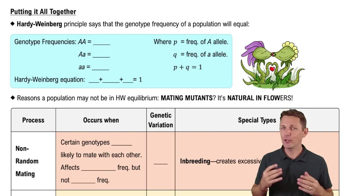
  • Hardy-Weinberg Principle

    A mathematical model predicting genotype frequencies in a population under specific equilibrium conditions.
  • Allele Frequency

    The proportion of a specific genetic variant among all gene copies in a population.
  • Genotype Frequency

    The proportion of individuals in a population with a particular genetic makeup.
  • Gene Pool

    The complete set of genetic information present in all individuals of a population.
  • Non-random Mating

    A reproductive pattern where certain genetic combinations are more likely to pair, altering genotype distribution.
  • Inbreeding

    A mating pattern among closely related individuals, increasing homozygosity and risk of deleterious traits.
  • Mutation

    A random change in genetic material that introduces new genetic variants into a population.
  • Point Mutation

    A genetic alteration affecting a single nucleotide, potentially creating new alleles.
  • Duplication

    A chromosomal event where a DNA segment is copied, possibly leading to new gene functions.
  • Horizontal Gene Transfer

    The movement of genetic material between different species, not through traditional inheritance.
  • Natural Selection

    A process where genetic variants that enhance survival and reproduction become more common over generations.
  • Genetic Drift

    Random fluctuations in allele frequencies, especially impactful in small populations, leading to genetic variation loss.
  • Founder Effect

    A reduction in genetic diversity when a new population is established by a small group from a larger population.
  • Population Bottleneck

    A sharp decrease in population size causing rapid genetic drift and loss of genetic diversity.
  • Gene Flow

    The transfer of genetic material between populations, increasing genetic variation and reducing population differences.