Back

r/K Selection definitions

Control buttons has been changed to "navigation" mode.
1/15
  • Life History

    Pattern of resource allocation to survival, growth, and reproduction unique to each species.
  • Natural Selection

    Evolutionary mechanism shaping traits that optimize survival and reproduction in specific environments.
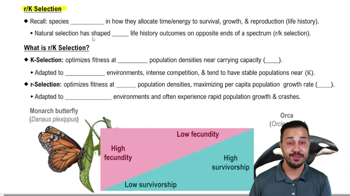
  • K Selection

    Strategy favoring traits that enhance survival and competitiveness in stable, crowded environments.
  • r Selection

    Strategy favoring rapid population increase and high reproductive output in unpredictable environments.
  • Carrying Capacity

    Maximum population size an environment can sustain without resource depletion.
  • Fecundity

    Potential reproductive output, often high in species with minimal parental care.
  • Parental Investment

    Amount of time, energy, or resources devoted to raising offspring.
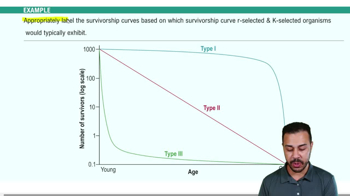
  • Type 1 Survivorship Curve

    Pattern with high early-life survival and increased mortality in later life stages.
  • Type 3 Survivorship Curve

    Pattern with high early-life mortality and few individuals surviving to adulthood.
  • Population Density

    Number of individuals per unit area, influencing competition and reproductive strategies.
  • Boom and Bust Cycle

    Population pattern marked by rapid growth followed by sudden decline.
  • Competition

    Interaction among organisms vying for limited resources in an environment.
  • Survivorship

    Proportion of individuals surviving at different stages of life within a population.
  • Offspring

    New individuals produced by a parent, varying in number and care among species.
  • Fitness

    Relative ability to survive and reproduce, contributing genes to future generations.