Skip to main content
General Biology
My Course
Learn
Exam Prep
AI Tutor
Study Guides
Textbook Solutions
Flashcards
Explore
Try the app
My Course
Learn
Exam Prep
AI Tutor
Study Guides
Textbook Solutions
Flashcards
Explore
Try the app
Back
Speciation Time Scales definitions
You can tap to flip the card.
Speciation
You can tap to flip the card.
👆
Speciation
A process linking small-scale genetic changes to large-scale evolutionary patterns, resulting in new distinct groups.
Track progress
Control buttons has been changed to "navigation" mode.
1/13
Related flashcards
Related practice
Recommended videos
Speciation Time Scales exam
Speciation Time Scales
27 Terms
Speciation Time Scales quiz #2
Speciation Time Scales
10 Terms
Speciation Time Scales
23. Speciation
5 problems
Topic
Hybrid Zones
23. Speciation
5 problems
Topic
23. Speciation - Part 1 of 2
5 topics
12 problems
Chapter
Brendan
23. Speciation - Part 2 of 2
1 topic
3 problems
Chapter
Guided course
03:23
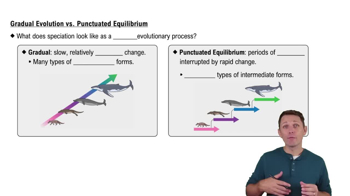
Gradual Evolution vs. Punctuated Equilibrium
2459
views
19
rank
Terms in this set (13)
Hide definitions
Speciation
A process linking small-scale genetic changes to large-scale evolutionary patterns, resulting in new distinct groups.
Microevolution
Small genetic changes within a population over generations, often leading to variation but not new groups.
Macroevolution
Large-scale evolutionary changes that result in the emergence of new groups over long time periods.
Gradual Evolution
A model describing slow, steady changes accumulating over millions of years, producing many transitional forms.
Punctuated Equilibrium
A model proposing long periods of little change interrupted by brief, rapid evolutionary shifts.
Fossil Record
Physical evidence preserved in rock layers, revealing patterns of evolutionary change and intermediate forms.
Intermediate Forms
Transitional organisms displaying traits between ancestral and modern species, often found in ancient remains.
Stasis
Extended periods during which species exhibit little or no evolutionary change.
Directional Selection
A process favoring extreme traits, leading to rapid shifts in a population's characteristics.
Stabilizing Selection
A process maintaining existing traits by favoring average individuals and reducing variation.
Biodiversity
The variety of living organisms shaped by evolutionary processes over time.
Transitional Fossils
Remains that illustrate evolutionary steps between major groups, supporting models of change.
Rapid Speciation
The quick emergence of new groups, often associated with environmental shifts or strong selection.
 BackBack
 03:23
03:23