 Back
BackAn Introduction to Carbohydrates: Structure, Function, and Biological Roles
Study Guide - Smart Notes
 Tailored notes based on your materials, expanded with key definitions, examples, and context.
Chapter 5: An Introduction to Carbohydrates
Overview of Carbohydrates
Carbohydrates are essential biomolecules that play critical roles in cell structure, cell identity, and energy storage. They are classified based on the number of monomer units:
Monosaccharides (“one-sugar”): Simple sugar monomers
Oligosaccharides (“few-sugars”): Short polymers of monosaccharides
Polysaccharides (“many-sugars”): Large polymers of monosaccharides
Carbohydrates have the general molecular formula (CH2O)n, where “n” can range from 3 to over a thousand. They contain a carbonyl group, multiple hydroxyl groups, and many carbon-hydrogen bonds.
5.1 Sugars as Monomers
Monosaccharides are the building blocks of carbohydrates and serve as sources of chemical energy and precursors for larger biomolecules. For example, ribose is required for nucleotide formation, which is essential for nucleic acids.
What Distinguishes One Monosaccharide from Another?
Monosaccharides vary in several structural features:
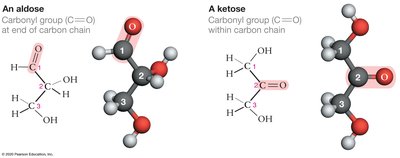
Location of the carbonyl group:
At the end of the molecule: Aldose
Within the molecule: Ketose
Number of carbon atoms:
Three: Triose
Five: Pentose
Six: Hexose
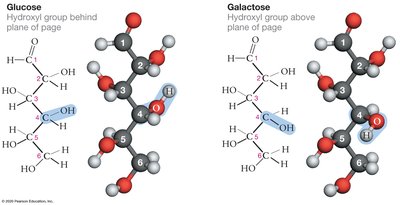
Spatial arrangement of atoms: The configuration of hydroxyl groups can differ, leading to different sugars (e.g., glucose vs. galactose).
Linear and ring forms: Sugars often form ring structures in aqueous solutions, and the position of certain groups (e.g., the hydroxyl on C-1) determines alpha (α) or beta (β) forms.

5.2 The Structure of Polysaccharides
Polysaccharides are polymers of monosaccharide monomers. Two monosaccharides joined together form a disaccharide. The linkage between sugars is formed by a condensation reaction between two hydroxyl groups, resulting in a covalent bond called a glycosidic linkage. These linkages can be broken by hydrolysis reactions.
Glycosidic linkages can form between any two hydroxyl groups.
Common linkages include α-1,4 and β-1,4 glycosidic bonds, which differ in geometry and functional properties.

Major Polysaccharides and Their Functions
Starch: Storage Polysaccharide in Plants
Starch is the primary storage form of sugar in plants. It consists of:
Amylose: Unbranched, only α-1,4-glycosidic linkages
Amylopectin: Branched, with some α-1,6-glycosidic linkages (branches occur about once every 30 monomers)

Glycogen: Storage Polysaccharide in Animals
Glycogen is the main storage polysaccharide in animals, found in liver and muscle cells. It is a highly branched α-glucose polymer, similar to starch, but with branches occurring about once every 10 monomers.
Cellulose: Structural Polysaccharide in Plants
Cellulose is a major component of plant cell walls. It consists of β-glucose monomers joined by β-1,4-glycosidic linkages, with every other glucose flipped. This generates a linear molecule and allows hydrogen bonds to form between adjacent strands, providing strength and rigidity.
Chitin: Structural Polysaccharide in Fungi and Animals
Chitin is found in fungal cell walls and the exoskeletons of insects and crustaceans. Its monomer is N-acetylglucosamine, and it forms linear strands with hydrogen bonds, similar to cellulose.
Peptidoglycan: Structural Polysaccharide in Bacteria
Peptidoglycan is a structural polymer in bacterial cell walls, consisting of alternating monosaccharides joined by β-1,4-glycosidic linkages and short amino acid chains forming peptide bonds between strands.

5.3 Functions of Carbohydrates in Cells
Carbohydrates serve diverse functions:
Precursors to other molecules (e.g., nucleotides, amino acids)
Provide fibrous structural materials (e.g., cellulose, chitin, peptidoglycan)
Indicate cell identity (e.g., glycoproteins, glycolipids)
Store chemical energy
Structural Support
Cellulose, chitin, and peptidoglycan form long strands with hydrogen bonds between adjacent strands, organized into fibers or sheets. These structures provide strength and elasticity to cells and organisms. The β-1,4-glycosidic linkages are resistant to hydrolysis, making these fibers difficult to break down and important as dietary fiber.
Role in Cell Identity
Carbohydrates on the cell surface act as identification badges. Glycoproteins (proteins with attached carbohydrates) and glycolipids (lipids with attached carbohydrates) are key molecules in cell–cell recognition and signaling.

Energy Storage and Release
Carbohydrates store chemical energy, which is harvested during photosynthesis and stored in their bonds. Starch and glycogen are easily hydrolyzed due to their α-glycosidic linkages. Enzymes such as phosphorylase (for glycogen) and amylase (for starch) catalyze the breakdown of these polysaccharides to release glucose.
Energy Utilization
When a cell requires energy, it breaks down glucose, and the captured energy is used to synthesize ATP. ATP then powers various cellular processes, including polymerization and muscle movement.
Summary Table: Polysaccharide Structures
Polysaccharide | Source | Monomer | Linkage | Structure |
|---|---|---|---|---|
Starch (Amylose/Amylopectin) | Plants | α-Glucose | α-1,4 and α-1,6 | Helical, branched |
Glycogen | Animals | α-Glucose | α-1,4 and α-1,6 | Highly branched |
Cellulose | Plants | β-Glucose | β-1,4 | Linear, fibrous |
Chitin | Fungi, Animals | N-acetylglucosamine | β-1,4 | Linear, fibrous |
Peptidoglycan | Bacteria | Alternating monosaccharides | β-1,4 + peptide bonds | Fibrous, cross-linked |
Key Equations
General formula for carbohydrates:
Condensation reaction (glycosidic bond formation):
Hydrolysis reaction (glycosidic bond cleavage):
Additional info: The notes have been expanded to include definitions, examples, and a summary table for clarity and completeness.
