 Back
BackAn Introduction to Ecology and the Biosphere (Campbell Biology, Ch. 52) – Study Notes
Study Guide - Smart Notes
 Tailored notes based on your materials, expanded with key definitions, examples, and context.
Introduction to Ecology and the Biosphere
What is Ecology?
Ecology is the scientific study of the interactions between organisms and the living (biotic) and nonliving (abiotic) components of their environment. These interactions determine the distribution and abundance of organisms on Earth.
Ecological questions include: What limits the geographic distribution of species? What factors affect population size?
Ecology is studied at multiple levels, from individual organisms to the entire biosphere.
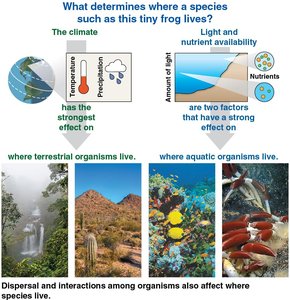
Levels of Ecological Study
Hierarchy of Ecological Research
Ecologists investigate questions at different levels of biological organization, each with a distinct focus:
Organismal Ecology: Examines how an organism’s structure, physiology, and behavior help it meet environmental challenges. Example: How do flamingos select a mate?
Population Ecology: Studies groups of individuals of the same species in an area, focusing on factors that affect population size and changes over time. Example: What environmental factors affect the reproductive rate of flamingos?
Community Ecology: Investigates interactions between species in a community and their effects on community structure and organization. Example: What factors influence species diversity at an African lake?
Ecosystem Ecology: Focuses on energy flow and chemical cycling among organisms and their environment within a community. Example: What controls photosynthetic productivity in aquatic ecosystems?
Landscape Ecology: Explores exchanges of energy, materials, and organisms across multiple ecosystems (landscapes or seascapes). Example: How do nutrients from terrestrial ecosystems affect lake organisms?
Global Ecology: Examines the biosphere as a whole, studying how energy and materials influence organisms globally. Example: How do global air circulation patterns affect organism distribution?
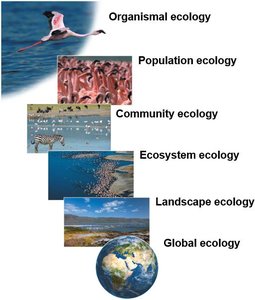
Earth’s Climate and Its Influence on Life
Climate: Definition and Components
Climate is the long-term prevailing weather conditions in an area. It is the most significant influence on the distribution of terrestrial organisms.
The four major physical components of climate are temperature, precipitation, sunlight, and wind.
Global Climate Patterns
Global climate is largely determined by solar energy and Earth’s movement in space. The intensity of sunlight varies with latitude, being most direct at the equator and more diffuse at higher latitudes.
Solar energy drives temperature variations, air and water circulation, and evaporation.
Latitudinal variation in sunlight intensity creates climate zones (tropics, temperate, polar).

Air Circulation and Precipitation Patterns
Intense sunlight at the equator causes warm, moist air to rise, releasing precipitation in the tropics. Dry air descends at about 30° north and south, creating arid climates (deserts). Air rises again at 60°, causing precipitation, and descends at the poles, creating cold, dry climates.

Regional and Local Effects on Climate
Seasonality: Caused by Earth’s tilt and orbit, leading to variations in day length, solar radiation, and temperature, especially at higher latitudes.
Bodies of Water: Oceans and lakes moderate climate due to water’s high specific heat. Ocean currents transport heat, influencing coastal climates.
Mountains: Affect air flow, precipitation (rain shadows), and sunlight exposure. Elevation changes temperature (about 6°C per 1,000 m).
Vegetation: Forests absorb more solar energy but also cool the environment via transpiration, increasing precipitation rates.
Microclimate: Localized climate patterns influenced by features like shade, wind, and soil moisture.
Global Climate Change
Human activities, such as burning fossil fuels and deforestation, have increased greenhouse gases, causing climate change. Effects include rising temperatures, shifting wind and precipitation patterns, and more frequent extreme weather events.
Species ranges are shifting; some species expand, others contract or face extinction.
Predicting future range shifts helps anticipate ecological impacts.
Terrestrial Biomes
Definition and Classification
Biomes are major life zones characterized by vegetation type (terrestrial) or physical environment (aquatic). Climate is a key factor in determining biome distribution.
Biomes are described by mean temperature and precipitation, as well as their annual patterns.
Ecotones are areas of transition between biomes.
Vertical layering of vegetation provides diverse habitats.
Convergent evolution can produce similar adaptations in distant biomes.
Major Terrestrial Biomes
Biome | Location | Climate | Vegetation | Animals | Human Impact |
|---|---|---|---|---|---|
Tropical Forest | Equatorial, subequatorial | High, constant or seasonal rainfall; warm | Evergreen or deciduous trees, layered | High diversity | Deforestation |
Desert | 30° N/S, interior continents | Low, variable precipitation; hot or cold | Heat/drought-adapted plants | Nocturnal, water-conserving | Urbanization, agriculture |
Savanna | Equatorial, subequatorial | Seasonal rainfall; warm | Grasses, fire-adapted forbs | Large herbivores, insects | Ranching, overhunting |
Chaparral | Midlatitude coasts | Rainy winters, dry summers | Shrubs, fire-adapted | Small mammals, birds | Agriculture, urbanization |
Temperate Grassland | Continents | Seasonal precipitation; cold winters, hot summers | Grasses, forbs | Grazers, burrowers | Agriculture, grazing |
Northern Coniferous Forest (Taiga) | Northern N. America, Eurasia | Cold winters, hot summers; moderate precipitation | Evergreen conifers | Large mammals, birds | Logging |
Temperate Broadleaf Forest | Midlatitudes | Significant precipitation; cold winters, hot summers | Deciduous trees | Mammals, birds, insects | Settlement, recovery |
Tundra | Arctic, alpine | Low precipitation; cold | Herbaceous, permafrost | Migratory birds, mammals | Resource extraction |
Aquatic Biomes
Characteristics and Zonation
Aquatic biomes are classified by physical and chemical environment, including salinity, depth, and water flow. Oceans cover about 75% of Earth’s surface and have a major impact on the biosphere.
Marine biomes: ~3% salt; freshwater: <0.1% salt.
Stratified into zones by light (photic/aphotic), depth, and temperature (thermocline).
Benthic zone: bottom substrate; benthos: organisms living there; detritus: food source for benthos.
Major Aquatic Biomes
Biome | Key Features | Producers | Animals | Human Impact |
|---|---|---|---|---|
Lakes | Oligotrophic (nutrient-poor, O2-rich), Eutrophic (nutrient-rich, O2-poor) | Phytoplankton, aquatic plants | Zooplankton, fish | Nutrient enrichment, fish kills |
Wetlands | Water-saturated soil, high productivity | Lilies, cattails, mosses | Invertebrates, birds, amphibians | Draining, filling |
Streams & Rivers | Current, headwaters (cold, clear), downstream (warm, turbid) | Phytoplankton, rooted plants | Fish, invertebrates | Pollution, damming |
Estuaries | Transition between river and sea, variable salinity | Saltmarsh grasses, algae | Fish, invertebrates, birds | Filling, pollution |
Intertidal Zones | Submerged/exposed by tides, high nutrients | Algae, seagrass | Sponges, worms, fish | Pollution, construction |
Oceanic Pelagic Zone | Open water, mixed by currents, low nutrients | Phytoplankton | Fish, squid, mammals | Overfishing, pollution |
Coral Reefs | Calcium carbonate skeletons, high diversity | Corals, algae | Fish, invertebrates | Warming, collection |
Marine Benthic Zone | Seafloor, cold, high pressure | Seaweeds, chemoautotrophs | Tube worms, fish | Overfishing, dumping |
Factors Limiting Species Distribution
Ecological and Evolutionary Influences
Species distributions are shaped by both ecological factors and evolutionary history. Dispersal, biotic interactions, and abiotic factors all play roles.
Dispersal: Movement of individuals or gametes away from origin; can expand range.
Species Transplants: Used to test if dispersal limits distribution; successful transplants may disrupt local ecosystems.
Biotic Factors: Predation, herbivory, competition, pollinators, pathogens, and food resources can limit survival and reproduction.
Abiotic Factors: Temperature, water, oxygen, salinity, sunlight, and soil properties affect organism distribution.
Examples of Limiting Factors
Temperature: Affects biological processes; most organisms function within a specific range.
Water and Oxygen: Availability is crucial; aquatic environments may have low oxygen in deep or organic-rich areas.
Salinity: Affects osmoregulation; most species are restricted to either freshwater or marine habitats.
Sunlight: Limits photosynthesis; too much light can be harmful (e.g., UV at high elevations).
Soil: pH, mineral content, and structure influence plant and animal distribution.
