Back
BackAnimal Behavior, Energy Flow, Population and Community Ecology
Study Guide - Smart Notes
 Tailored notes based on your materials, expanded with key definitions, examples, and context.
Animal Behavior and Communication
Behavioral and Physiological Responses to the Environment
Organisms respond to environmental changes through a variety of behavioral and physiological mechanisms. These responses are essential for survival and reproductive success.
Behavioral responses include migration, hibernation, and communication.
Physiological responses involve internal adjustments such as thermoregulation and metabolic changes.
Communication between organisms can be visual, tactile, auditory, chemical, or electrical, each adapted to specific environmental contexts.
Types of Communication
Organisms use different signaling mechanisms to convey information, which can influence behavior and reproductive success.
Visual signals: e.g., peacock displays.
Auditory signals: e.g., bird songs, mating calls.
Chemical signals: e.g., pheromone trails in ants, scent marking in dogs.
Tactile signals: e.g., grooming, mating dances.
Electrical signals: used by some aquatic animals.
Auditory signals are most effective for long-distance communication in the dark, while chemical signals are efficient for long-distance signaling underwater.
Innate vs. Learned Behaviors
Animal behaviors can be classified as innate (inborn) or learned (acquired through experience).
Innate behaviors: Genetically programmed and present at birth (e.g., spider spinning a web).
Learned behaviors: Acquired through trial and error or observation (e.g., crows using tools).
Associative learning includes:
Classical conditioning: Associating a neutral stimulus with a significant one (e.g., Pavlov's dogs).
Operant conditioning: Behavior shaped by rewards or punishments.
Imprinting: Rapid learning during a sensitive period, often leading to recognition of parents or species-specific behaviors.
Cross-fostering can disrupt imprinting, leading to behavioral isolation.

Altruism and Cooperative Behavior
Altruism refers to selfless behaviors that increase the fitness of other individuals or the population, often at a cost to the individual (e.g., alarm calls in Belding's squirrels). Cooperative behaviors can enhance survival and reproductive success, influencing natural selection.
Energy Flow Through Ecosystems
Metabolic Strategies: Endotherms vs. Ectotherms
Organisms use energy to maintain organization, grow, and reproduce. They employ different strategies to regulate body temperature and metabolism:
Endotherms: Generate heat through metabolism (e.g., mammals, birds). Require more food and oxygen, especially at low temperatures.
Ectotherms: Rely on environmental heat sources (e.g., reptiles, amphibians). Lower metabolic rates and food requirements.
Smaller organisms have higher metabolic rates per unit body mass due to greater surface area-to-volume ratios, leading to increased heat loss.
Energy Acquisition and Use
Autotrophs: Capture energy from sunlight (photosynthesis) or inorganic molecules (chemosynthesis).
Heterotrophs: Obtain energy by metabolizing organic compounds produced by other organisms (carbohydrates, lipids, proteins).
Nucleic acids are generally not used as energy sources by heterotrophs.
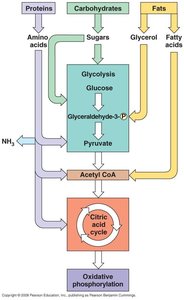
Energy Balance and Population Dynamics
Net energy gain leads to growth and energy storage.
Net energy loss results in loss of mass and potentially death.
Changes in energy availability can alter population sizes and disrupt ecosystems.
Population Ecology
Population Growth Models
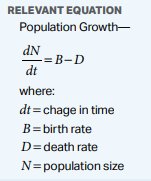
Population size changes are determined by births, deaths, immigration, and emigration. The basic population growth equation is:
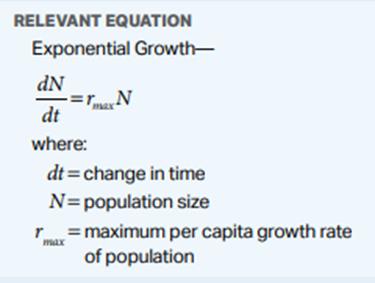
Exponential growth occurs when resources are unlimited:
Logistic growth incorporates carrying capacity (K):
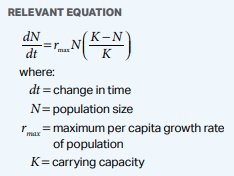
Carrying capacity (K): Maximum population size the environment can support.
As N approaches K, growth rate slows and eventually stops (dN/dt = 0 when N = K).
Density-Dependent and Density-Independent Factors
Density-dependent factors: Effects increase with population density (e.g., disease, competition).
Density-independent factors: Effects are unrelated to population density (e.g., natural disasters).
Community Ecology
Community Structure and Species Diversity
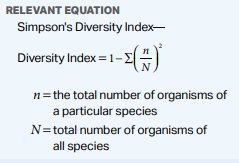
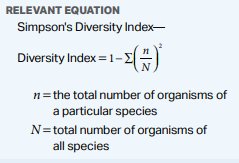
Community structure is described by species composition and diversity. Species richness is the number of different species present.
Simpson's Diversity Index quantifies diversity:
Species Interactions
Competition (-/-): Both species are harmed.
Predation (+/-): Predator benefits, prey is harmed.
Mutualism (+/+): Both species benefit.
Parasitism (+/-): Parasite benefits, host is harmed.
Cooperation: Enhances access to energy and matter.
Resource partitioning allows species with overlapping niches to coexist by dividing resources.
Trophic Structure and Keystone Species
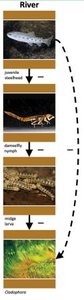
Trophic interactions determine energy flow and population dynamics. Keystone species have a disproportionate effect on ecosystem stability; their removal can cause ecosystem collapse.
Biodiversity and Ecosystem Stability
Resilience and Keystone Species
Communities with higher diversity and more component parts are more resilient to environmental changes.
Keystone species, producers, and essential abiotic/biotic factors maintain ecosystem diversity.
Disruptions to Ecosystems
Adaptations and Invasive Species
Adaptations: Genetic variations favored by selection that provide advantages in specific environments.
Mutations: Random changes in DNA that can lead to adaptations if beneficial.
Invasive species: Can experience exponential growth due to lack of natural predators and unlimited resources, often outcompeting native species and altering ecosystem diversity.
Human and Environmental Impacts
Human activities (e.g., habitat change, introduction of new diseases, fertilizer runoff) can disrupt ecosystems and accelerate changes at local and global scales.
Abiotic factors (nonliving) and biotic factors (living) both influence ecosystem structure and function.
Appendix: Key Equations and Diagrams
Population Growth Equations
Population Growth:
Exponential Growth:
Logistic Growth:
Simpson's Diversity Index