 Back
BIO 1020 Exam #3 Study Guide – Fungi, Animal Evolution, and Phylogeny
Study Guide - Smart Notes
 Tailored notes based on your materials, expanded with key definitions, examples, and context.
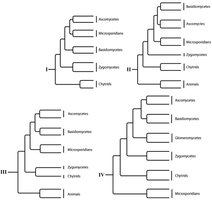
Q10. Which tree depicts all of the currently recognized major groups of fungi?
Background
Topic: Fungal Phylogeny
This question tests your understanding of the evolutionary relationships among the major groups of fungi. You need to recognize the main fungal clades and how they are represented in phylogenetic trees.
Key Terms and Concepts:
Phylogenetic tree: A diagram showing evolutionary relationships among organisms.
Major fungal groups: Chytrids, Zygomycetes, Glomeromycetes, Ascomycetes, Basidiomycetes, Microsporidians.
Step-by-Step Guidance
Review the names of the major fungal groups and their evolutionary relationships as discussed in your class notes and textbook.
Examine each tree (I, II, III, IV) and check if all major groups are present and correctly related.
Look for the inclusion of Microsporidians, which are sometimes omitted in older classifications but are now recognized as a major group.
Compare the branching patterns to see which tree best matches the current scientific consensus.
Try solving on your own before revealing the answer!
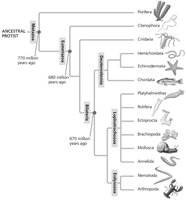
Q31. In the figure below, the Deuterostomia clade is most closely related to which two main clades?
Background
Topic: Animal Phylogeny
This question asks you to interpret a phylogenetic tree of animals and identify which clades are most closely related to Deuterostomia. Understanding the major animal clades and their relationships is essential.
Key Terms and Concepts:
Deuterostomia: A major clade of animals that includes echinoderms and chordates.
Lophotrochozoa and Ecdysozoa: The two other main clades of bilaterian animals.
Phylogenetic tree reading: Identifying sister groups and close relationships based on branching points.
Step-by-Step Guidance
Locate the Deuterostomia branch on the provided phylogenetic tree.
Identify the two main clades that are most closely related to Deuterostomia by following the branching points.
Recall that the three main bilaterian clades are Deuterostomia, Lophotrochozoa, and Ecdysozoa.
Check the tree to confirm which clades are grouped together at the same major node as Deuterostomia.
Try solving on your own before revealing the answer!
