 Back
BackBiology 105 Study Guide: Foundations of Life, Cells, Chemistry, Immunity, and Respiration
Study Guide - Smart Notes
 Tailored notes based on your materials, expanded with key definitions, examples, and context.
Humans in the World of Biology
Basic Characteristics of Living Things
All living organisms share several fundamental characteristics that distinguish them from non-living matter. These features are essential for life and are observed across all domains of biology.
Contain nucleic acids, proteins, carbohydrates, and lipids: These biomolecules are universal to all living things. DNA (deoxyribonucleic acid) is especially important for heredity and reproduction.
Composed of cells: Cells are the smallest units of life. Organisms may be unicellular (one cell) or multicellular (many cells).
Grow and reproduce: Reproduction can be asexual (one parent) or sexual (two parents combining genetic material).
Use energy and raw materials: Metabolism refers to all chemical reactions in cells, enabling growth and maintenance.
Respond to their environment: Sensory organs and nervous systems detect and respond to stimuli.
Maintain homeostasis: Internal conditions are regulated within certain limits for stability.
Adapt and evolve: Populations acquire adaptive traits through natural selection, leading to evolution.
Evolution and Biological Classification
Domains and Kingdoms of Life
Biological classification organizes life into three domains and several kingdoms, reflecting evolutionary relationships and cellular structure.
Domain Bacteria: Unicellular prokaryotes, lack a nucleus.
Domain Archaea: Unicellular prokaryotes, often live in extreme environments.
Domain Eukarya: Eukaryotic cells with a membrane-bound nucleus and internal compartments. Includes four kingdoms: Protists, Fungi, Plants, Animals.
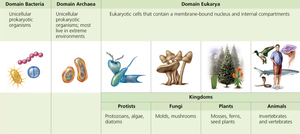
Humans belong to the Animal kingdom, specifically the vertebrates and mammals, and are classified as primates.
Levels of Biological Organization
Hierarchy of Life
Life is organized from the smallest to the largest levels, each with increasing complexity.
Population: Group of the same species in one area.
Community: All species living and interacting in one area.
Ecosystem: Community plus non-living environment (water, soil, air).
Biosphere: All ecosystems on Earth.
The Scientific Method
Steps in Scientific Investigation
The scientific method is a systematic approach to answering questions about the natural world, ensuring reliable and reproducible results.
Observation
Form a question
Hypothesis (possible explanation)
Prediction
Experiment (controlled setup)
Results
Conclusion
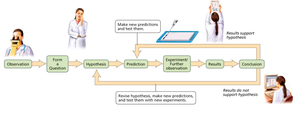
Variables: Independent (changed/tested), dependent (measured), and confounding (extra, confusing results). Control: Standard for comparison.
Reasoning: Inductive (generalize from observations), Deductive (predict from general rule).
Chemistry Comes to Life
The Nature of Atoms
Atoms are the fundamental units of matter, composed of subatomic particles:
Protons: Positive charge, in nucleus.
Neutrons: Neutral, in nucleus.
Electrons: Negative charge, orbit nucleus in shells.
Atomic number: Number of protons. Atomic mass: Protons + neutrons. Isotopes: Same element, different neutrons.
Chemical Bonds and Compounds
Atoms combine via chemical bonds to form molecules and compounds. The main types of bonds are:
Type | Basis for Attraction | Strength | Example |
|---|---|---|---|
Covalent | Sharing of electrons | Strongest | CH4 (methane) |
Ionic | Transfer of electrons, attraction of oppositely charged ions | Strong | NaCl (table salt) |
Hydrogen | Attraction between hydrogen and electronegative atom | Weak | Between water molecules |

The Cell
Prokaryotic vs. Eukaryotic Cells
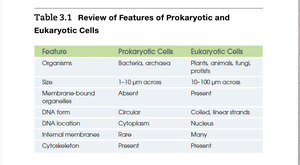
Cells are classified as prokaryotic or eukaryotic based on their structure and complexity.
Feature | Prokaryotic Cells | Eukaryotic Cells |
|---|---|---|
Organisms | Bacteria, archaea | Plants, animals, fungi, protists |
Size | 1–10 μm | 10–100 μm |
Membrane-bound organelles | Absent | Present |
DNA form | Circular | Linear strands |
DNA location | Cytoplasm | Nucleus |
Internal membranes | Rare | Many |
Cytoskeleton | Present | Present |
Cell Size and Surface-to-Volume Ratio
Cell size is limited by the surface-to-volume ratio, which affects nutrient and waste exchange.
Measurement | Small Cell | Large Cell |
|---|---|---|
Surface area | 6 | 216 |
Volume | 1 | 216 |
Surface-to-volume ratio | 6:1 | 1:1 |
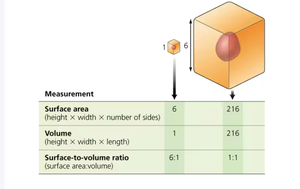
Additional info: Smaller cells are more efficient at exchanging materials due to higher surface-to-volume ratios.
Movement Across the Plasma Membrane
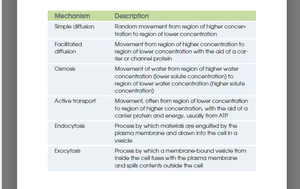
Cells use various mechanisms to transport substances across the plasma membrane:
Mechanism | Description |
|---|---|
Simple diffusion | Random movement from high to low concentration |
Facilitated diffusion | Movement via carrier protein |
Osmosis | Movement of water across membrane |
Active transport | Movement against concentration gradient, requires energy |
Endocytosis | Engulfing materials into cell |
Exocytosis | Expelling materials from cell |
Cell Organelles and Their Functions
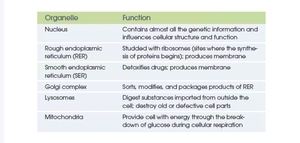
Eukaryotic cells contain specialized organelles, each with distinct functions:
Organelle | Function |
|---|---|
Nucleus | Contains genetic information, influences cell function |
Rough ER | Protein synthesis, produces membrane |
Smooth ER | Detoxifies drugs, produces membrane |
Golgi complex | Sorts, modifies, packages products |
Lysosomes | Digest waste and old cell parts |
Mitochondria | Produce energy (ATP) via cellular respiration |
Body Defense Mechanisms: Immunity
Active vs. Passive Immunity
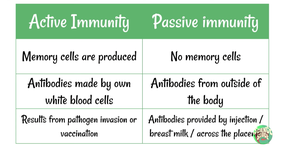
The immune system protects the body through two main types of immunity:
Active Immunity | Passive Immunity |
|---|---|
Memory cells produced | No memory cells |
Antibodies made by own white blood cells | Antibodies from outside the body |
Results from infection or vaccination | Provided by injection, breast milk, or placenta |
Self vs. Nonself: MHC Markers and Antigens
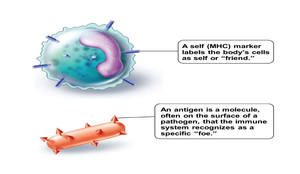
The immune system distinguishes self from nonself using molecular markers:
MHC (Major Histocompatibility Complex) markers: Label cells as "self" to prevent immune attack.
Antigens: Foreign molecules (often on pathogens) recognized as "foe" by the immune system.
Immunological Memory: Primary and Secondary Response
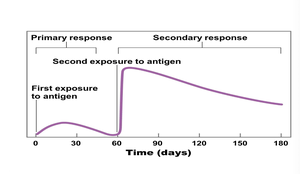
Immunological memory allows the body to respond more rapidly and effectively to repeated exposures to the same antigen.
Primary response: Slow, occurs after first exposure.
Secondary response: Faster and stronger, due to memory cells.
The Respiratory System
Structure and Function of the Larynx and Epiglottis
The larynx is a key structure in the respiratory system, responsible for voice production and preventing food from entering the airway. The epiglottis covers the larynx during swallowing.
Larynx: Air passageway, voice production.
Epiglottis: Prevents food/drink from entering the trachea during swallowing.
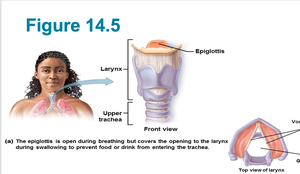
Additional info: Failure of the epiglottis mechanism can result in coughing or choking.
