Back
Biology 115: Circulation, Gas Exchange, and Plant Physiology Study Guidance
Study Guide - Smart Notes
 Tailored notes based on your materials, expanded with key definitions, examples, and context.
Q26. What features of water explain how it can be drawn up a tall tree from roots to leaves?
Background
Topic: Plant Transport – Water Movement
This question tests your understanding of the physical and chemical properties of water that enable it to move upward against gravity in plants, a process essential for plant survival and growth.
Key Terms and Concepts:
Cohesion: The attraction between water molecules due to hydrogen bonding.
Adhesion: The attraction between water molecules and the walls of plant vessels (xylem).
Water Potential Gradient: The difference in water potential from roots (higher) to leaves (lower), driving water movement upward.
Step-by-Step Guidance
Recall that water moves from areas of higher water potential (roots) to lower water potential (leaves and air) in plants.
Consider how cohesion allows water molecules to stick together, forming a continuous column in the xylem.
Think about how adhesion helps water molecules cling to the walls of xylem vessels, preventing the column from breaking.
Remember that transpiration (evaporation of water from leaves) creates a negative pressure that pulls water upward.
Combine these concepts to explain how water can travel up even the tallest trees.
Try solving on your own before revealing the answer!
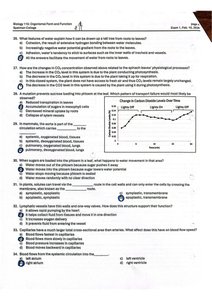
Q27. How are the changes in CO2 concentration observed above related to the spinach leaves' physiological processes?
Background
Topic: Photosynthesis and Gas Exchange in Plants
This question asks you to interpret a graph showing changes in CO2 concentration over time and relate it to plant physiological processes, specifically photosynthesis and respiration.
Key Terms and Concepts:
Photosynthesis: The process by which plants use light energy to convert CO2 and water into glucose and oxygen.
Respiration: The process by which plants (and all organisms) break down glucose to produce energy, releasing CO2.
CO2 Uptake: During photosynthesis, plants remove CO2 from their environment.
Step-by-Step Guidance
Examine the graph and note whether CO2 levels are increasing or decreasing over time.
Recall that during photosynthesis, plants use CO2, which would decrease its concentration in a closed system.
Consider what would happen to CO2 levels if the plant were only respiring (not photosynthesizing).
Think about the experimental conditions (e.g., light on/off) and how they affect photosynthesis and CO2 uptake.
Try solving on your own before revealing the answer!
Q28. A mutation prevents sucrose loading into phloem at the leaf. Which pattern of transport failure would most likely be observed?
Background
Topic: Phloem Transport and Source-Sink Relationships in Plants
This question tests your understanding of how sugars are transported in plants and what happens when this process is disrupted.
Key Terms and Concepts:
Phloem: Vascular tissue responsible for transporting sugars from sources (leaves) to sinks (roots, fruits, etc.).
Sucrose Loading: The active process of moving sucrose into phloem sieve tubes at the source.
Source-Sink Relationship: The movement of sugars from areas of production (source) to areas of use or storage (sink).
Step-by-Step Guidance
Recall that sucrose must be loaded into the phloem for transport to occur from leaves to other parts of the plant.
Think about what would happen to sugar levels in the leaf if loading is blocked.
Consider the downstream effects on plant growth and energy distribution if sugars cannot reach sinks.
Try solving on your own before revealing the answer!
Q29. In mammals, the aorta is part of the __ circulation which carries __ to the __.
Background
Topic: Circulatory System – Systemic and Pulmonary Circulation
This question tests your knowledge of the structure and function of the mammalian circulatory system, specifically the role of the aorta.
Key Terms and Concepts:
Aorta: The main artery that carries blood from the heart to the body.
Systemic Circulation: The pathway that carries oxygenated blood from the heart to the tissues and returns deoxygenated blood to the heart.
Pulmonary Circulation: The pathway that carries deoxygenated blood from the heart to the lungs and returns oxygenated blood to the heart.
Step-by-Step Guidance
Recall the path of blood flow from the heart to the body and back, and the distinction between systemic and pulmonary circuits.
Identify whether the aorta carries oxygenated or deoxygenated blood, and to which part of the body.
Match the correct terms to the blanks in the question based on your understanding of the circulatory system.
Try solving on your own before revealing the answer!
Q30. When sugars are loaded into the phloem in a leaf, what happens to water movement in that area?
Background
Topic: Phloem Loading and Water Potential
This question tests your understanding of how the loading of sugars into the phloem affects water movement due to changes in water potential.
Key Terms and Concepts:
Water Potential: The potential energy of water in a system, influencing the direction of water movement.
Osmosis: The movement of water from areas of higher to lower water potential.
Phloem Loading: The process of actively transporting sugars into the phloem, lowering water potential and causing water to enter by osmosis.
Step-by-Step Guidance
Recall that loading sugars into the phloem decreases the water potential inside the phloem.
Think about how water moves in response to water potential gradients.
Predict the direction of water movement when sugar concentration increases in the phloem.
Try solving on your own before revealing the answer!
Q31. In plants, solutes can travel via the _____ route in the cell walls and can only enter the cells by crossing the membrane, also known as the _____ route.
Background
Topic: Plant Transport Pathways – Apoplastic and Symplastic Routes
This question tests your understanding of the two main pathways for solute movement in plant tissues.
Key Terms and Concepts:
Apoplastic Route: Movement of solutes through cell walls and spaces between cells, without crossing membranes.
Symplastic Route: Movement of solutes through the cytoplasm of cells, connected by plasmodesmata, requiring crossing of membranes.
Transmembrane Route: Movement of solutes across cell membranes multiple times.
Step-by-Step Guidance
Recall the definitions of apoplastic, symplastic, and transmembrane routes in plant tissues.
Think about which route involves movement through cell walls and which requires crossing the plasma membrane.
Match the correct terms to the blanks in the question.
Try solving on your own before revealing the answer!
Q32. Lymphatic vessels have thin walls and one-way valves. How does this structure support their function?
Background
Topic: Lymphatic System Structure and Function
This question tests your understanding of how the structure of lymphatic vessels supports their role in fluid balance and immune function.
Key Terms and Concepts:
Lymphatic Vessels: Vessels that collect excess fluid from tissues and return it to the bloodstream.
One-way Valves: Structures that prevent backflow, ensuring fluid moves in one direction.
Thin Walls: Allow for easy uptake of fluid from tissues.
Step-by-Step Guidance
Recall the function of the lymphatic system in collecting and returning interstitial fluid to the circulatory system.
Think about how thin walls facilitate fluid entry and how one-way valves prevent backflow.
Relate these structural features to the efficient movement of lymph.
Try solving on your own before revealing the answer!
Q33. Capillaries have a much larger total cross-sectional area than arteries. What effect does this have on blood flow speed?
Background
Topic: Circulatory System – Blood Flow Dynamics
This question tests your understanding of how the structure of blood vessels affects the speed of blood flow and the exchange of materials.
Key Terms and Concepts:
Capillaries: Smallest blood vessels where exchange of nutrients and wastes occurs.
Cross-sectional Area: The total area through which blood can flow in a given type of vessel.
Blood Flow Speed: Inversely related to total cross-sectional area; as area increases, speed decreases.
Step-by-Step Guidance
Recall that the total cross-sectional area of capillaries is much greater than that of arteries.
Think about how this affects the velocity of blood flow according to the principle of continuity (flow rate = area × velocity).
Consider why slower blood flow in capillaries is beneficial for nutrient and gas exchange.
Try solving on your own before revealing the answer!
Q34. Blood flows from the systemic circulation into the _____.
Background
Topic: Circulatory System – Blood Flow Pathways
This question tests your knowledge of the sequence of blood flow through the heart and major vessels.
Key Terms and Concepts:
Systemic Circulation: Pathway carrying blood from the body back to the heart.
Right Atrium: Chamber of the heart that receives deoxygenated blood from the body.
Left Atrium: Chamber that receives oxygenated blood from the lungs.
Step-by-Step Guidance
Recall the path of blood returning from the body to the heart.
Identify which chamber of the heart receives blood from the systemic veins.
Match the correct chamber to the blank in the question.
Try solving on your own before revealing the answer!