 Back
elthing L1
Study Guide - Smart Notes
 Tailored notes based on your materials, expanded with key definitions, examples, and context.
Introduction to the Chemistry of Life
Overview of Biological Molecules
Biological systems are fundamentally based on the chemistry of carbon and its ability to form diverse molecules. Understanding the structure and function of these molecules is essential for studying cell biology and physiology.
Key Elements: The main elements in biological molecules are carbon (C), hydrogen (H), oxygen (O), and nitrogen (N).
Organic Chemistry: Focuses on carbon-containing compounds, which are the foundation of life.
Biomolecules: Include carbohydrates, lipids, proteins, and nucleic acids.
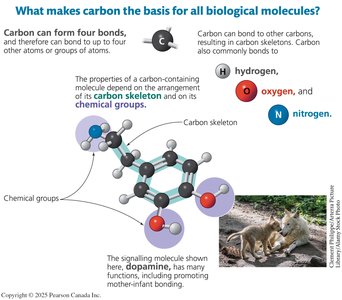
Organic Chemistry and the Role of Carbon
Properties of Carbon
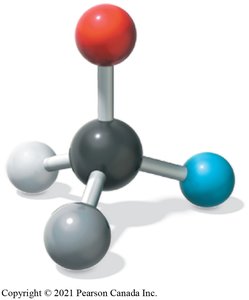
Carbon is unique in its ability to form four covalent bonds, allowing for a variety of stable and complex molecules. This versatility makes carbon the backbone of all biological macromolecules.
Tetravalence: Carbon can form four bonds, leading to a diversity of molecular shapes and sizes.
Bonding: Carbon bonds with other carbons, hydrogens, oxygens, and nitrogens to create chains, rings, and complex structures.
Biological Relevance: The arrangement of carbon atoms determines the structure and function of biomolecules.
Origin of Organic Molecules
The origin of organic molecules on Earth is a fundamental question in biology. The Miller-Urey experiment demonstrated that organic molecules could be synthesized abiotically under early Earth conditions.
Stanley Miller Experiment (1953): Simulated early Earth atmosphere and produced amino acids and other organic compounds.
Implication: Organic molecules may have formed before the first living organisms.

Carbon Atoms Forming Molecules
Structure and Diversity of Carbon Compounds
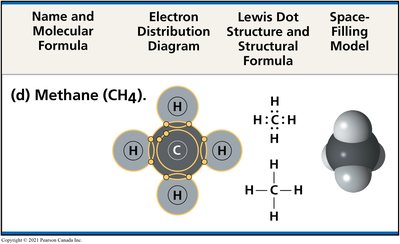
Carbon atoms can form single, double, or triple bonds, resulting in molecules with different shapes and properties. The three-dimensional structure of these molecules is crucial for their biological function.
Methane (CH4): Simplest hydrocarbon, tetrahedral geometry.
Ethane (C2H6): Single bond between carbons, allows free rotation.
Ethene (C2H4): Double bond, planar structure, restricted rotation.

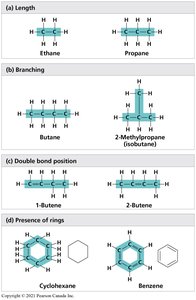
Structural Variation in Carbon Skeletons
Carbon skeletons can vary in length, branching, double bond position, and ring formation, contributing to molecular diversity.
Length: Chains of different lengths (e.g., ethane vs. propane).
Branching: Straight or branched chains (e.g., butane vs. isobutane).
Double Bonds: Position of double bonds affects properties (e.g., 1-butene vs. 2-butene).
Rings: Formation of cyclic structures (e.g., cyclohexane, benzene).

Isomerism in Organic Molecules
Isomers are compounds with the same molecular formula but different structures, leading to different properties.
Structural Isomers: Differ in covalent arrangement of atoms.
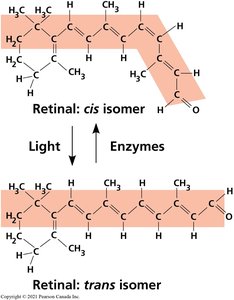
Cis-Trans Isomers: Differ in spatial arrangement around double bonds.
Enantiomers: Mirror images due to asymmetric (chiral) carbon atoms; important in biology due to different biological activities.


Chemical Groups and Molecular Function
Functional Groups in Biological Molecules
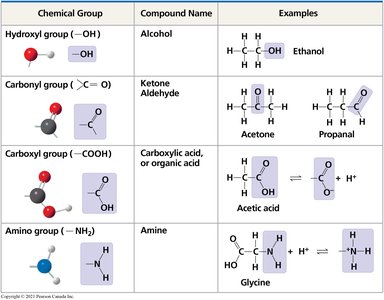
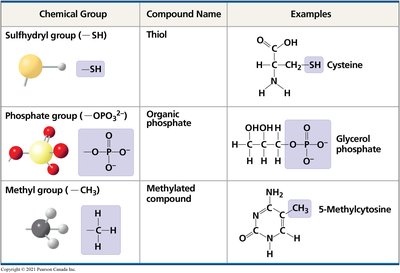
Chemical groups attached to carbon skeletons determine the properties and functions of organic molecules. These groups participate in characteristic chemical reactions.
Chemical Group | Compound Name | Examples |
|---|---|---|
Hydroxyl (–OH) | Alcohol | Ethanol |
Carbonyl (C=O) | Ketone, Aldehyde | Acetone, Propanal |
Carboxyl (–COOH) | Carboxylic acid | Acetic acid |
Amino (–NH2) | Amine | Glycine |
Chemical Group | Compound Name | Examples |
|---|---|---|
Sulfhydryl (–SH) | Thiol | Cysteine |
Phosphate (–OPO32–) | Organic phosphate | Glycerol phosphate |
Methyl (–CH3) | Methylated compound | 5-Methylcytosine |
ATP: The Energy Currency of the Cell
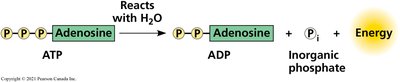
Adenosine triphosphate (ATP) is a nucleotide that stores and transfers energy within cells. Hydrolysis of ATP releases energy used for cellular work.
ATP Structure: Adenosine (adenine + ribose) and three phosphate groups.
Hydrolysis Reaction:
Functional Groups and Hormone Structure
Small differences in functional groups can lead to significant differences in biological activity, as seen in steroid hormones like estradiol and testosterone.
Estradiol vs. Testosterone: Both are steroids with similar carbon skeletons but differ in functional groups, resulting in different physiological effects.

The Molecules of Life
Macromolecules and Their Building Blocks
Life is based on four major classes of macromolecules: carbohydrates, lipids, proteins, and nucleic acids. Each class has unique structures and functions essential for cellular processes.
Carbohydrates: Energy storage and structural support.
Lipids: Membrane structure, energy storage, signaling.
Proteins: Catalysis, structure, transport, signaling.
Nucleic Acids: Storage and transmission of genetic information.
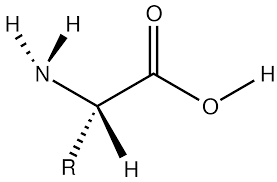
Additional info: The diversity and complexity of biological molecules arise from the versatility of carbon chemistry and the functional groups attached to carbon skeletons. Understanding these principles is foundational for further study in cell biology, physiology, and biochemistry.
