 Back
BackBiology I: Cellular Respiration, Photosynthesis, Cell Cycle, and Meiosis – Exam 3 Study Guide
Study Guide - Smart Notes
 Tailored notes based on your materials, expanded with key definitions, examples, and context.
Cellular Respiration and Fermentation
Overview and Function
Cellular respiration is a series of metabolic processes that break down organic molecules, such as glucose, to generate ATP, the main energy currency of the cell. This process allows cells to efficiently convert the energy stored in food into a usable form, minimizing energy loss as heat.
Primary Function: To produce ATP by oxidizing glucose and other fuels.
Comparison: Unlike burning fuel (which releases all energy at once), cellular respiration releases energy in controlled steps.
Redox Reactions in Metabolism
Redox (reduction-oxidation) reactions are central to energy transfer in cells. They involve the transfer of electrons between molecules.
Oxidation: Loss of electrons.
Reduction: Gain of electrons.
Oxidizing Agent: Electron acceptor (becomes reduced).
Reducing Agent: Electron donor (becomes oxidized).
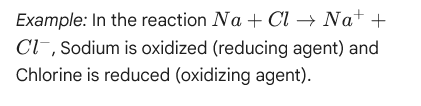
Example: In the reaction , sodium is oxidized (reducing agent) and chlorine is reduced (oxidizing agent).
Coenzymes in Catabolism
NAD+ and FAD: Main electron carriers derived from vitamins (niacin/B3 and riboflavin/B2, respectively).
Reduction: NAD+ accepts 2 electrons and 1 proton to become NADH.
Oxidation: NADH donates electrons and a proton to return to NAD+.
Phases of Cellular Respiration
Cellular respiration consists of four main phases: Glycolysis, Pyruvate Oxidation, Citric Acid Cycle, and Electron Transport Chain (ETC). Each phase occurs in a specific cellular location and has distinct inputs and outputs.
Phase | Location | Starting Materials | Final Products | NADH/FADH2 | CO2 Produced? | ATP Produced | Main Accomplishment |
|---|---|---|---|---|---|---|---|
Glycolysis | Cytosol | Glucose, 2 ATP, NAD+ | 2 Pyruvate, 2 NADH | 2 NADH | No | 2 Net | Split glucose |
Pyruvate Oxidation | Mitochondrial Matrix | 2 Pyruvate, NAD+, CoA | 2 Acetyl CoA, 2 NADH, 2 CO2 | 2 NADH | Yes (2) | 0 | Prep pyruvate for cycle |
Citric Acid Cycle | Mitochondrial Matrix | 2 Acetyl CoA, NAD+, FAD | 2 ATP, 6 NADH, 2 FADH2, 4 CO2 | 6 NADH, 2 FADH2 | Yes (4) | 2 | Extract high-energy electrons |
Electron Transport Chain | Inner Mitochondrial Membrane | NADH, FADH2, O2 | ATP, H2O, NAD+, FAD | None (used up) | No | ~26-28 | Convert electron energy to ATP |
Energy Transfer and Chemiosmosis
Energy from glucose is transferred to NADH/FADH2, which donate electrons to the ETC.
The ETC pumps H+ ions, creating a proton-motive force.
ATP synthase uses this gradient to synthesize ATP from ADP and Pi (chemiosmosis).
Electron Transport Chain and ATP Synthesis
Electrons lose energy as they move through the ETC.
The energy is used to pump H+ ions, generating a gradient (proton-motive force).
ATP synthase produces ATP as H+ flows back into the matrix.
Oxygen is the final electron acceptor, forming water as a byproduct.
Phosphorylation Mechanisms
Substrate-level phosphorylation: Direct transfer of phosphate to ADP (in glycolysis and citric acid cycle).
Oxidative phosphorylation: ATP synthesis powered by the ETC and chemiosmosis (in the inner mitochondrial membrane).
Fermentation and Anaerobic Respiration
Fermentation: Allows glycolysis to continue by recycling NAD+ in the absence of oxygen. Yields 2 ATP per glucose.
Types: Alcohol fermentation (yeast, produces ethanol and CO2), lactic acid fermentation (muscle cells, bacteria, produces lactate).
Anaerobic respiration: Uses an ETC with a final electron acceptor other than oxygen (e.g., sulfate or nitrate).
Other Fuels and Biosynthesis
Fats and proteins can enter cellular respiration at various points (e.g., fatty acids as acetyl CoA).
Catabolic pathways provide carbon skeletons for anabolic pathways to synthesize biomolecules.
Photosynthesis
Overview and Function
Photosynthesis is the process by which autotrophs convert light energy into chemical energy, producing organic molecules and oxygen. It is essential for life on Earth, forming the base of the food web and maintaining atmospheric oxygen.
Autotrophs: Producers that build organic molecules from CO2 (e.g., plants, algae, some bacteria).
Heterotrophs: Consumers that obtain organic molecules from other organisms (e.g., animals, fungi).
Carbon Cycle: Autotrophs fix CO2; both autotrophs and heterotrophs return CO2 via respiration.
Photosynthesis Equation and Reactant Fate
The summary equation for photosynthesis is:
CO2: Reduced to form glucose.
H2O: Oxidized to form O2.
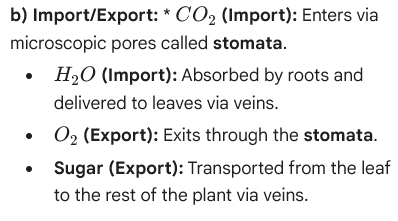
Import/Export of Reactants and Products:
CO2 (Import): Enters via stomata (microscopic pores).
H2O (Import): Absorbed by roots, delivered via veins.
O2 (Export): Exits through stomata.
Sugar (Export): Transported from leaves to the rest of the plant via veins.
Light Reactions and Calvin Cycle
Light Reactions: Occur in the thylakoid membranes; produce ATP and NADPH for the Calvin Cycle.
Calvin Cycle: Occurs in the stroma; uses ATP and NADPH to fix CO2 into G3P (a 3-carbon sugar).
Pigments and Light Absorption
Pigments: Absorb specific wavelengths; reflected/transmitted wavelengths are seen as color (e.g., green for chlorophyll).
Chlorophyll: Absorbs blue-violet and red; reflects green.
Accessory Pigments: Broaden the spectrum of usable light (e.g., carotenoids).
Electron Flow in Light Reactions
Photon excites pigment; energy transferred to reaction center.
Electron transferred to primary acceptor; replaced by splitting water (releases O2).
Electron passes through ETC, generating ATP (chemiosmosis), then re-excited in PS I and reduces NADP+ to NADPH.
Photorespiration and Adaptations
Photorespiration: Occurs when RuBisCo fixes O2 instead of CO2 (hot, dry conditions).
C4 Plants: Spatial separation of steps to maintain high CO2 for RuBisCo.
CAM Plants: Temporal separation; fix CO2 at night, use it during the day.
The Cell Cycle
Phases and Purpose
Cell Cycle: Interphase (G1, S, G2) and Mitotic (M) Phase (mitosis and cytokinesis).
Purpose: Growth, development, repair (multicellular); reproduction (unicellular).
Stages of Mitosis
Prophase: Chromosomes condense, spindle forms.
Prometaphase: Nuclear envelope fragments, spindle attaches to kinetochores.
Metaphase: Chromosomes align at metaphase plate.
Anaphase: Sister chromatids separate.
Telophase: Nuclei reform, chromosomes decondense.
Cytokinesis: Cytoplasm divides (cleavage furrow in animals, cell plate in plants).
Genetic Material Terminology
DNA: Genetic information molecule.
Gene: Unit of information within DNA.
Genome: Complete set of DNA.
Chromosome: DNA molecule with proteins.
Replicated Chromosome: Two sister chromatids.
Sister Chromatids: Identical copies, separated in anaphase.
Chromatin: DNA-protein complex.
Cell Cycle Control and Cancer
Checkpoints: G1 (before S), G2 (before M), M (before anaphase).
Cyclins and Cdks: Cyclins regulate Cdks; MPF triggers mitosis.
Cancer: Loss of cell cycle control; cells divide uncontrollably.
Tumor: Mass of abnormal cells; Malignancy: Invades tissues; Metastasis: Spreads to other sites.
Meiosis and Sexual Life Cycles
Homologous Chromosomes and Genetic Variation
Homologous Chromosomes: Pairs with genes for same traits; one from each parent.
Alleles: Different versions of a gene.
Autosomes: Non-sex chromosomes; Sex Chromosomes: X and Y in humans.
Somatic Cells vs. Gametes
Feature | Somatic Cells | Gametes |
|---|---|---|
Ploidy | Diploid (2n) | Haploid (n) |
Chromosome Number (humans) | 46 | 23 |
Location | All body cells (except germ-line) | Gonads (testes/ovaries) |
Meiosis: Process and Outcomes
Meiosis I: Homologous chromosomes separate (Prophase I, Metaphase I, Anaphase I, Telophase I & Cytokinesis).
Meiosis II: Sister chromatids separate (Prophase II, Metaphase II, Anaphase II, Telophase II & Cytokinesis).
Results in four genetically unique haploid cells.
Comparison: Mitosis vs. Meiosis
Feature | Mitosis | Meiosis |
|---|---|---|
Number of cell divisions | One | Two |
Number of daughter cells | Two | Four |
Crossing over? | No | Yes (Prophase I) |
Ploidy BEFORE | Diploid (2n) | Diploid (2n) |
Ploidy AFTER | Diploid (2n) | Haploid (n) |
Function in animals | Growth, repair, maintenance | Reproduction (gametes) |
Sources of Genetic Diversity
Mutations: Create new alleles.
Independent Assortment: Random orientation of homologs in Metaphase I.
Crossing Over: Exchange of DNA between nonsister chromatids in Prophase I.
Random Fertilization: Any sperm can fertilize any egg, increasing combinations.
