 Back
BackBiology I Honors Semester II Exam Review – Step-by-Step Study Guidance
Study Guide - Smart Notes
 Tailored notes based on your materials, expanded with key definitions, examples, and context.
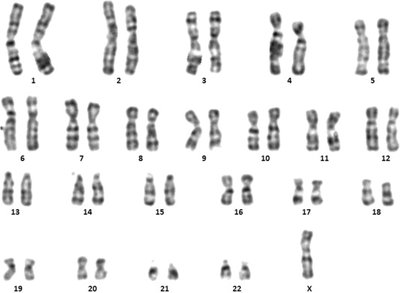
Q53. What is the following illustration, and why is it an important tool? Is this a normal set of human chromosomes? Why or why not? Is this a male or female? Can you identify a genetic disorder?
Background
Topic: Human Karyotypes and Chromosomal Disorders
This question is testing your understanding of karyotypes, how to interpret them, and how they are used to diagnose chromosomal abnormalities and determine biological sex.
Key Terms and Concepts:
Karyotype: An organized profile of a person's chromosomes, arranged in pairs by size and shape.
Autosomes: Chromosomes 1–22, which are the same in both males and females.
Sex Chromosomes: The X and Y chromosomes that determine biological sex (XX = female, XY = male).
Chromosomal Disorder: A condition caused by an abnormal number or structure of chromosomes (e.g., Down syndrome, Turner syndrome).
Step-by-Step Guidance
Examine the image and identify what it represents. Notice that the chromosomes are arranged in pairs and labeled 1–22, with an additional pair labeled X (or Y).
Recall that a normal human karyotype has 22 pairs of autosomes and one pair of sex chromosomes. Count the total number of chromosomes and check for any extra or missing chromosomes.
Determine the biological sex by looking at the sex chromosomes: XX indicates female, XY indicates male.
Look for any abnormalities, such as an extra chromosome (trisomy), a missing chromosome (monosomy), or structural changes. Common examples include three copies of chromosome 21 (Down syndrome) or a single X chromosome (Turner syndrome).
Think about why karyotypes are important tools in genetics and medicine. Consider how they help diagnose genetic disorders and provide information about an individual's chromosomes.
Try solving on your own before revealing the answer!
Final Answer:
This is a human karyotype, which is used to examine the number and structure of chromosomes. In this karyotype, there are 22 pairs of autosomes and one X chromosome, indicating Turner syndrome (a female with only one X chromosome). This is not a normal set of human chromosomes because there is a missing sex chromosome. Karyotypes are important for diagnosing chromosomal disorders and determining biological sex.
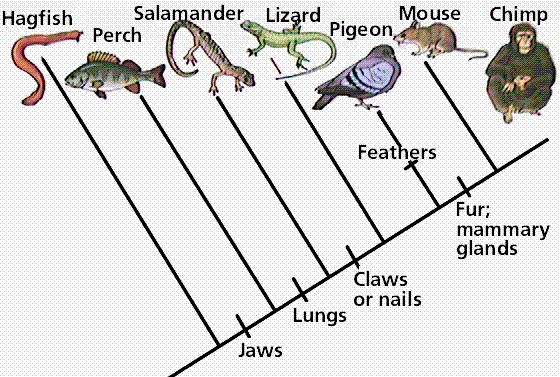
Q72. By analyzing the cladogram above, which organism do all of the others share as a common ancestor? Did lungs evolve before or after feathers? Which organism evolved most recently?
Background
Topic: Evolutionary Relationships and Cladograms
This question is testing your ability to interpret a cladogram, which is a diagram that shows evolutionary relationships among organisms based on shared characteristics.
Key Terms and Concepts:
Cladogram: A branching diagram showing the evolutionary relationships among species.
Common Ancestor: The most recent ancestral species from which all organisms in the group are descended.
Derived Characteristic: A trait that evolved in the lineage leading up to a clade and that sets members of that clade apart from other individuals.
Step-by-Step Guidance
Start at the base (leftmost side) of the cladogram to identify the earliest ancestor shared by all organisms shown.
Follow the branches to see where each new trait (e.g., jaws, lungs, claws, feathers, fur) appears. Traits that appear lower on the diagram evolved earlier.
To determine if lungs evolved before or after feathers, locate both traits on the diagram and compare their positions.
To find the most recently evolved organism, look for the organism at the tip of the branch that is farthest to the right.
Try solving on your own before revealing the answer!
Final Answer:
All the organisms share the hagfish as a common ancestor. Lungs evolved before feathers, as indicated by their positions on the cladogram. The chimp is the most recently evolved organism shown on this diagram.
