 Back
Biology Lab Practical 2 Review – Photosynthesis, Cellular Respiration, GMOs, DNA, PCR, and Mitosis
Study Guide - Smart Notes
 Tailored notes based on your materials, expanded with key definitions, examples, and context.
Q1. How do you determine the volume for each micropipette (P20, P200, P1000)?
Background
Topic: Laboratory Techniques – Micropipetting
This question tests your understanding of how to read and set the correct volume on different types of micropipettes, which is essential for accurate measurement in biological experiments.
Key Terms and Concepts:
P20: Measures 2–20 µL
P200: Measures 20–200 µL
P1000: Measures 200–1000 µL
Step-by-Step Guidance
Look at the display window on each pipette to read the set volume. Each pipette has a different scale and number of digits.
For a P20, the numbers represent tens, ones, and tenths of a microliter (e.g., 154 = 15.4 µL).
For a P200, the numbers represent hundreds, tens, and ones of a microliter (e.g., 087 = 87 µL).
For a P1000, the numbers represent thousands, hundreds, and tens of a microliter (e.g., 250 = 250 µL).
Try solving on your own before revealing the answer!
Q2. What is the chemical equation for cellular respiration? What organelle carries out cellular respiration? What product were you collecting in the beakers?
Background
Topic: Cellular Respiration
This question tests your knowledge of the process of cellular respiration, the organelle responsible, and the experimental detection of its products.
Key Terms and Formulas:
Cellular Respiration Equation:
Organelle: Mitochondrion
Product Collected: Carbon dioxide ()
Step-by-Step Guidance
Recall the balanced equation for aerobic cellular respiration.
Identify the organelle where this process occurs in eukaryotic cells.
Think about what you exhale and what dissolves in water to change its pH during the experiment.
Try solving on your own before revealing the answer!
Q3. Based on the exercise experiment graph: What is the independent variable? What is the dependent variable? Is cellular respiration occurring more during rest or exercise? Explain your answer.
Background
Topic: Experimental Design and Data Interpretation
This question assesses your ability to interpret experimental data and identify variables in a biological experiment.
Key Terms:
Independent Variable: The variable you change (e.g., rest vs. exercise)
Dependent Variable: The variable you measure (e.g., amount of produced or pH change)
Step-by-Step Guidance
Look at the x-axis of the graph to identify the independent variable.
Look at the y-axis to identify the dependent variable.
Compare the results for rest and exercise to determine when cellular respiration is higher.
Think about why exercise would affect the rate of cellular respiration.
Try solving on your own before revealing the answer!
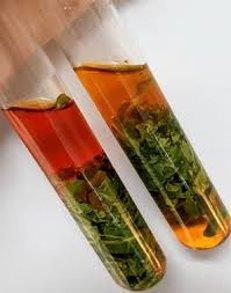
Q4. What happens to the pH of water when carbon dioxide is added? What was the pH indicator used in this experiment? Label the cups as acidic, neutral, or basic. What color was the indicator after exercise? Why?
Background
Topic: Acid-Base Chemistry and Indicators in Biology
This question tests your understanding of how affects pH and how pH indicators are used to detect these changes.
Key Terms:
pH: A measure of hydrogen ion concentration; lower pH = more acidic.
Indicator: A chemical that changes color depending on pH (e.g., phenol red).
Step-by-Step Guidance
Recall what happens when dissolves in water (forms carbonic acid).
Think about how this affects the pH (acidic, neutral, or basic).
Identify the indicator used (often phenol red in these experiments).
Use the color chart for the indicator to label the cups and explain the color change after exercise.
Try solving on your own before revealing the answer!
Q5. Write the chemical equation for photosynthesis. What organelle carries out photosynthesis? What type of carbon and energy source do photoautotrophs and chemoheterotrophs utilize?
Background
Topic: Photosynthesis and Metabolic Diversity
This question tests your knowledge of the photosynthesis equation, the organelle involved, and the differences between photoautotrophs and chemoheterotrophs.
Key Terms and Formulas:
Photosynthesis Equation:
Organelle: Chloroplast
Photoautotrophs: Use as a carbon source and light as an energy source.
Chemoheterotrophs: Use organic molecules for both carbon and energy.
Step-by-Step Guidance
Recall the balanced equation for photosynthesis.
Identify the organelle where photosynthesis occurs in plant cells.
Define the carbon and energy sources for both photoautotrophs and chemoheterotrophs.
Try solving on your own before revealing the answer!
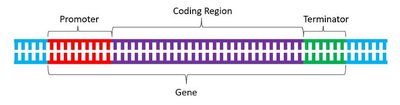
Q6. Label the following image of a gene found in DNA. What are the two common genetic regulatory sequences found in GM foods?
Background
Topic: Genetic Engineering and Gene Structure
This question tests your understanding of gene structure and the regulatory elements used in genetically modified organisms (GMOs).
Key Terms:
Promoter: DNA sequence that initiates transcription of a gene.
Terminator: DNA sequence that signals the end of transcription.
Coding Region: The part of the gene that is transcribed and translated into protein.
Step-by-Step Guidance
Identify the promoter, coding region, and terminator on the gene diagram.
Recall the names of common regulatory sequences used in GM foods (e.g., CaMV 35S promoter, NOS terminator).
Try solving on your own before revealing the answer!
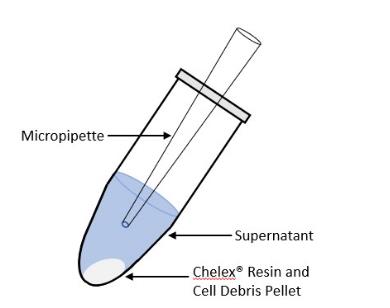
Q7. DNA Extraction: How do you separate cells, break open cells, and inactivate enzymes? Why is Chelex used? What equipment is used to separate debris and homogenize samples?
Background
Topic: DNA Extraction Techniques
This question tests your understanding of the steps and reagents used in DNA extraction from plant material.
Key Terms:
Chelex: A resin that binds metal ions to inhibit DNases.
Homogenization: Physically breaking up tissue to release cells.
Centrifuge: Used to separate cell debris from DNA-containing supernatant.
Step-by-Step Guidance
Describe how you physically separate and break open cells (e.g., grinding, vortexing).
Explain the role of Chelex in protecting DNA from degradation.
Identify the equipment used for separating debris (centrifuge) and for homogenizing (homogenizer or pestle).
Try solving on your own before revealing the answer!
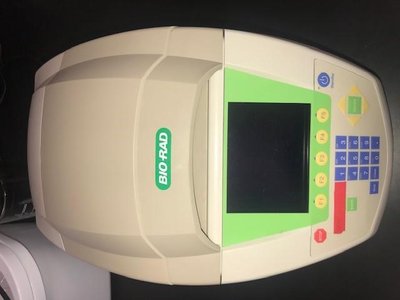
Q8. What does PCR stand for? What is its purpose in this experiment? What instrument is used? Why are the steps repeated 40 times?
Background
Topic: Polymerase Chain Reaction (PCR)
This question tests your understanding of PCR, its purpose in detecting GMOs, and the equipment used.
Key Terms:
PCR: Polymerase Chain Reaction
Thermocycler: Instrument used to automate PCR cycles.
Amplification: Repeating cycles to exponentially increase DNA copies.
Step-by-Step Guidance
State what PCR stands for and its main function in molecular biology.
Explain why PCR is used in GMO detection (to amplify specific DNA sequences).
Identify the instrument used (thermocycler).
Discuss why the process is repeated for many cycles (to generate enough DNA for detection).
Try solving on your own before revealing the answer!
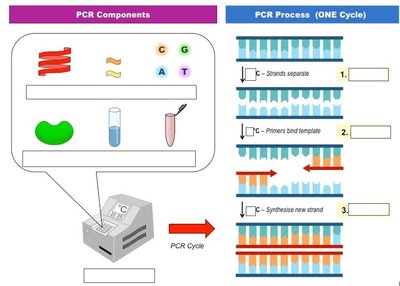
Q9. Label the steps of PCR (denaturation, annealing, extension) and match the correct temperatures. What is the purpose of MgCl2 in PCR?
Background
Topic: PCR Mechanism and Components
This question tests your understanding of the three main steps of PCR and the role of magnesium chloride.
Key Terms:
Denaturation: Separates DNA strands (usually ~94–95°C).
Annealing: Primers bind to DNA (usually ~50–65°C).
Extension: DNA polymerase synthesizes new DNA (usually ~72°C).
MgCl2: Cofactor required for DNA polymerase activity.
Step-by-Step Guidance
Label each step of the PCR cycle and match it to the correct temperature range.
Explain the function of MgCl2 in the reaction.
Try solving on your own before revealing the answer!
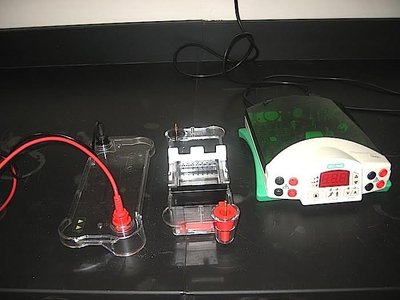
Q10. What is the name and purpose of the technology shown (gel electrophoresis)? How does it separate DNA?
Background
Topic: Gel Electrophoresis
This question tests your understanding of how gel electrophoresis is used to separate DNA fragments by size.
Key Terms:
Gel Electrophoresis: Technique for separating DNA fragments based on size using an electric field.
Agarose Gel: The medium through which DNA migrates.
Step-by-Step Guidance
Name the technology and describe its main purpose in molecular biology.
Explain how DNA fragments are separated (smaller fragments move faster/farther).
Describe the role of the electric field and the gel matrix.
Try solving on your own before revealing the answer!
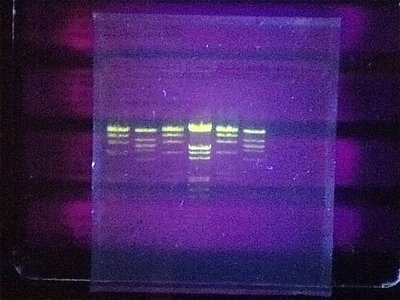
Q11. What do the bands represent in a gel? Which pieces of DNA are largest? What charge does DNA have? Which end is the positive electrode?
Background
Topic: Interpreting Gel Electrophoresis Results
This question tests your ability to interpret the results of a DNA gel and understand the movement of DNA in an electric field.
Key Terms:
Bands: Represent DNA fragments of specific sizes.
DNA Charge: DNA is negatively charged due to its phosphate backbone.
Electrodes: DNA migrates toward the positive (red) electrode.
Step-by-Step Guidance
Explain what each band on the gel represents.
Determine which end of the gel is positive and which is negative.
Identify which bands correspond to the largest and smallest DNA fragments.
Try solving on your own before revealing the answer!
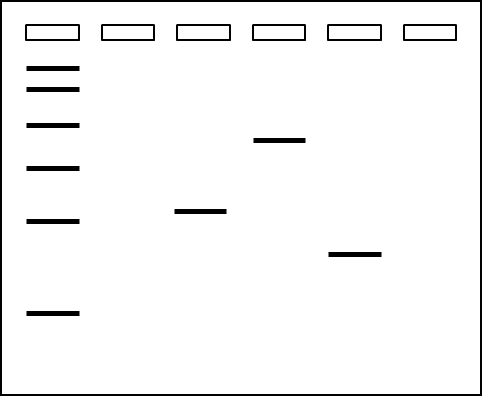
Q12. Based on the gel image, which lanes are negative DNA controls, negative GMO controls, and positive GMO controls? What was the purpose of the plant primers?
Background
Topic: Controls in Molecular Biology Experiments
This question tests your understanding of experimental controls and the use of primers in PCR-based GMO detection.
Key Terms:
Negative Control: Should not produce a band; confirms no contamination.
Positive Control: Should produce a band; confirms the reaction worked.
Plant Primers: Amplify a gene present in all plants to confirm DNA extraction was successful.
Step-by-Step Guidance
Identify which lanes correspond to each control based on the gel image and sample loading order.
Explain the purpose of including plant primers in the experiment.
Try solving on your own before revealing the answer!
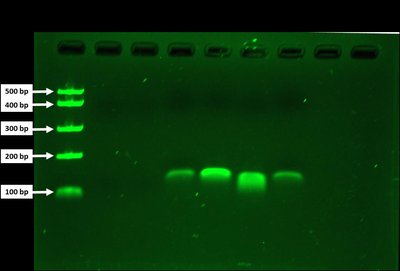
Q13. Based on the gel image below, which food is genetically modified? (P = plant primers, GMO = NOS/CaMV35 primers)
Background
Topic: GMO Detection Using PCR and Gel Electrophoresis
This question tests your ability to interpret PCR results to determine if a food sample contains genetically modified DNA.
Key Terms:
P (Plant Primers): Confirms plant DNA is present.
GMO Primers: Detects presence of GMO-specific sequences.
Step-by-Step Guidance
Compare the bands in the "P" and "GMO" lanes for each sample.
Identify which sample(s) show a band in the GMO lane, indicating the presence of GMO DNA.
Try solving on your own before revealing the answer!
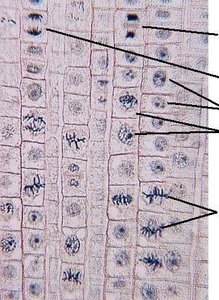
Q14. Label the stages of the cell cycle and mitosis in onion root cells. Why are root tips used? Identify cells in prophase, metaphase, anaphase, and telophase.
Background
Topic: Mitosis and Cell Cycle
This question tests your ability to identify and describe the stages of mitosis and understand why certain tissues are used for observation.
Key Terms:
Prophase: Chromosomes condense, nuclear envelope breaks down.
Metaphase: Chromosomes align at the cell equator.
Anaphase: Sister chromatids separate to opposite poles.
Telophase: Nuclear envelopes reform, chromosomes decondense.
Cytokinesis: Division of the cytoplasm.
Step-by-Step Guidance
Label each stage of the cell cycle and mitosis on the provided image.
Explain why onion root tips are ideal for observing mitosis (actively dividing cells).
Identify and describe the appearance of cells in each mitotic phase.
Try solving on your own before revealing the answer!
