 Back
BackBiology Study Guide: Nucleic Acids, Protein Synthesis, and Cellular Processes
Study Guide - Smart Notes
 Tailored notes based on your materials, expanded with key definitions, examples, and context.
Q1. What must be true of the change in Gibbs free energy (G) for the two reactions in order for them to be coupled during nucleic acid synthesis?
Background
Topic: Thermodynamics of biochemical reactions
This question tests your understanding of how energy is transferred and used during the synthesis of DNA or RNA, specifically through the coupling of reactions involving phosphodiester bond formation and the hydrolysis of nucleoside triphosphates.
Key Terms and Formulas:
Gibbs free energy (): Indicates whether a reaction is energetically favorable.
Phosphodiester bond: The linkage between nucleotides in DNA/RNA.
Nucleoside triphosphate hydrolysis: Provides energy for biosynthetic reactions.
Step-by-Step Guidance
Recall that for two reactions to be coupled, the overall must be negative (energetically favorable).
Formation of a phosphodiester bond is energetically unfavorable, so its is positive.
Hydrolysis of nucleoside triphosphates (breaking phosphate-phosphate bonds) is energetically favorable, so its is negative.
For coupling to work, the magnitude of the negative from hydrolysis must be greater than the positive $\Delta G$ from bond formation.
Try solving on your own before revealing the answer!
Q2. Identify which process does each of the following: produces RNA complementary to DNA, produces a polypeptide from mRNA, produces two identical DNA molecules from one.
Background
Topic: Central Dogma of Molecular Biology
This question tests your knowledge of transcription, translation, and DNA replication.
Key Terms:
Transcription: Synthesis of RNA from DNA template.
Translation: Synthesis of protein from mRNA.
DNA synthesis (replication): Copying DNA to produce identical molecules.
Step-by-Step Guidance
Match each process to its description: RNA synthesis (transcription), protein synthesis (translation), DNA copying (replication).
Recall the directionality and templates used in each process.
Think about the products: RNA, polypeptide, or DNA.
Try solving on your own before revealing the answer!
Q3. Identify the molecules found in DNA, RNA, and protein from the structures shown.
Background
Topic: Structure of biological macromolecules
This question tests your ability to recognize the chemical structures of nucleotides and amino acids.
Key Terms:
Ribonucleotide: Found in RNA.
Deoxyribonucleotide: Found in DNA.
Amino acid: Building block of proteins.
Step-by-Step Guidance
Examine each structure for distinguishing features: ribose vs. deoxyribose, presence of amino and carboxyl groups.
Identify which molecule has a 2' OH group (ribonucleotide) and which has a 2' H (deoxyribonucleotide).
Look for the amino acid structure: central carbon, amino group, carboxyl group, and side chain.
Compare the structures to typical nucleotide and amino acid diagrams.
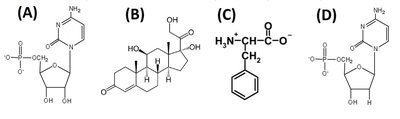
Try solving on your own before revealing the answer!
Q4. Where in a eukaryotic cell would each of the following processes occur?
Background
Topic: Cell structure and function
This question tests your understanding of cellular compartments and where key processes like protein synthesis and nucleic acid synthesis occur.
Key Terms:
Ribosomes: Sites of protein synthesis.
Rough ER: Location for synthesis of membrane-bound proteins.
Nucleus: Site of DNA replication and transcription.
Step-by-Step Guidance
Recall that glycolytic enzymes are synthesized in the cytoplasm.
Membrane proteins are synthesized at the rough ER.
Transcription and DNA replication occur in the nucleus.
Try solving on your own before revealing the answer!
Q5. Which processes are used by a cell to synthesize a protein from a protein-coding gene?
Background
Topic: Gene expression
This question tests your understanding of the steps required to go from DNA to protein.
Key Terms:
Transcription: DNA to RNA.
Translation: RNA to protein.
DNA replication and mitosis are not directly involved in protein synthesis.
Step-by-Step Guidance
Identify which processes are part of the central dogma (transcription and translation).
Eliminate processes that do not directly contribute to protein synthesis.
Try solving on your own before revealing the answer!
Q6. Where does DNA replication, RNA synthesis, and protein synthesis start?
Background
Topic: Initiation sites for molecular processes
This question tests your knowledge of the specific locations or sequences where these processes begin.
Key Terms:
Origin of replication: Start site for DNA replication.
Promoter and +1 site: Start site for RNA synthesis.
Start codon: Initiation site for protein synthesis.
Step-by-Step Guidance
Recall the sequence or location for each process: origin for DNA, promoter/+1 for RNA, start codon for protein.
Think about how each process recognizes its initiation site.
Try solving on your own before revealing the answer!
Q7. Which enzyme catalyzes the bond between monomers during DNA, RNA, and protein synthesis?
Background
Topic: Enzymes in macromolecule synthesis
This question tests your knowledge of the specific enzymes responsible for polymerization in DNA, RNA, and protein synthesis.
Key Terms:
DNA polymerase: Catalyzes DNA synthesis.
RNA polymerase: Catalyzes RNA synthesis.
Ribosome: Catalyzes peptide bond formation during translation.
Step-by-Step Guidance
Recall the enzyme for each process: DNA polymerase for DNA, RNA polymerase for RNA, ribosome for protein.
Think about the type of bond formed: phosphodiester for nucleic acids, peptide for proteins.
Try solving on your own before revealing the answer!
Q8. Match the type of RNA to its function: snRNA, mRNA, rRNA, tRNA.
Background
Topic: Types of RNA and their roles
This question tests your knowledge of the different classes of RNA and their functions in gene expression and processing.
Key Terms:
snRNA: Involved in splicing.
mRNA: Messenger RNA, template for translation.
rRNA: Ribosomal RNA, catalyzes peptide bond formation.
tRNA: Transfers amino acids to ribosome.
Step-by-Step Guidance
Match each RNA type to its described function.
Recall the role of each in the central dogma and gene expression.
Try solving on your own before revealing the answer!
Q9. What is the mRNA sequence produced from a DNA template strand?
Background
Topic: Transcription and base pairing
This question tests your ability to transcribe a DNA sequence into RNA, considering directionality and base pairing rules.
Key Terms:
Template strand: The DNA strand used for RNA synthesis.
Antiparallel: RNA is synthesized in the opposite direction to the template.
Base pairing: A-U, C-G in RNA.
Step-by-Step Guidance
Write out the DNA template strand.
Determine the complementary RNA sequence using base pairing rules.
Ensure the RNA is written 5' to 3' and is antiparallel to the DNA template.
Try solving on your own before revealing the answer!
Q10. Given an mRNA sequence, identify the start and stop codons and the amino acid sequence.
Background
Topic: Translation and genetic code
This question tests your ability to interpret an mRNA sequence, identify codons, and use the genetic code to determine the amino acid sequence.
Key Terms:
Start codon: AUG (methionine).
Stop codon: UAG, UAA, UGA (no amino acid).
Codon: Three-nucleotide sequence coding for an amino acid.
Step-by-Step Guidance
Group the mRNA sequence into codons (sets of three nucleotides).
Identify the start codon (AUG) and stop codon (UAG).
Use a codon table to determine the amino acid for each codon between start and stop.
Write out the sequence of amino acids called for by the codons.
Try solving on your own before revealing the answer!
Q11. What is the result of splicing in eukaryotic cells?
Background
Topic: RNA processing
This question tests your understanding of how splicing can affect gene expression and protein diversity.
Key Terms:
Splicing: Removal of introns and joining of exons in mRNA.
Alternative splicing: Produces multiple mRNAs and proteins from one gene.
Step-by-Step Guidance
Recall that splicing can generate different mRNA variants from the same gene.
Think about how this increases protein diversity in eukaryotes.
Try solving on your own before revealing the answer!
Q12. What is the effect of different mutations on protein structure?
Background
Topic: Mutations and their consequences
This question tests your understanding of how changes in DNA sequence can affect the resulting protein.
Key Terms:
Missense mutation: Changes one amino acid.
Frameshift mutation: Alters reading frame, affecting all downstream amino acids.
Silent mutation: No change in amino acid.
Step-by-Step Guidance
Identify the type of mutation: substitution, deletion, or silent.
Predict the effect on the protein: single amino acid change, frameshift, or no change.
Try solving on your own before revealing the answer!
Q13. True or false: In prokaryotic cells, transcription and translation can occur simultaneously.
Background
Topic: Gene expression in prokaryotes vs. eukaryotes
This question tests your understanding of cellular organization and how it affects gene expression.
Key Terms:
Prokaryotes: No nucleus, so processes can occur together.
Eukaryotes: Transcription in nucleus, translation in cytoplasm.
Step-by-Step Guidance
Recall that prokaryotes lack a nucleus, allowing ribosomes to access mRNA as it is being transcribed.
Contrast with eukaryotes, where mRNA must be processed and exported before translation.
Try solving on your own before revealing the answer!
