 Back
BackBiomolecules: Macromolecules and Carbohydrates
Study Guide - Smart Notes
 Tailored notes based on your materials, expanded with key definitions, examples, and context.
Biomolecules: Macromolecules and Carbohydrates
Introduction to Biomolecules
Biomolecules are essential organic molecules found in living organisms, playing critical roles in structure and function. The four major classes are carbohydrates, lipids, proteins, and nucleic acids. Carbohydrates, proteins, and nucleic acids are polymers, built from repeating monomer units.
Polymer: A long molecule consisting of many similar or identical building blocks (monomers) linked by covalent bonds.
Monomer: The repeating unit that serves as the building block of a polymer.
Carbohydrates
Introduction to Carbohydrates
Carbohydrates, also known as saccharides, are the most abundant biological molecules. They are straight-chain aldehydes or ketones with the general formula (CH2O)n. Carbohydrates serve as energy storage, structural components, and play roles in immune function, fertilization, and development.
Functions:
Storage and transport of energy (e.g., starch, glycogen)
Structural components (e.g., cellulose in plants, chitin in animals)
Roles in immune system, fertilization, pathogenesis, blood clotting, and development
Monosaccharides
Monosaccharides are the simplest carbohydrates, often referred to as "simple sugars." They are the basic units from which more complex carbohydrates are built.
Classification: Based on three characteristics:
Placement of the carbonyl group (Aldose or Ketose)
Number of carbon atoms (Triose, Tetrose, Pentose, Hexose, etc.)
Chiral handedness (D or L isomer)
Chirality: Determined by the asymmetric carbon atom furthest from the carbonyl group. The orientation of the hydroxyl group on this carbon determines D or L configuration.
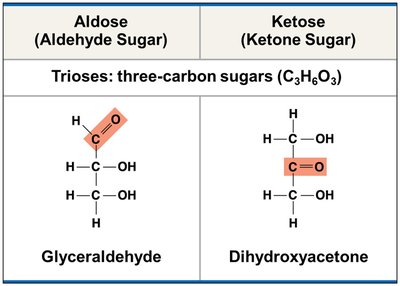
Examples of Monosaccharides
Aldose (Aldehyde Sugar) | Ketose (Ketone Sugar) |
|---|---|
Glyceraldehyde (Triose) | Dihydroxyacetone (Triose) |
Ribose (Pentose) | Ribulose (Pentose) |
Glucose, Galactose (Hexose) | Fructose (Hexose) |
Disaccharides
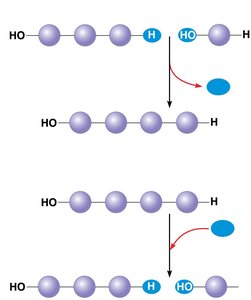
Disaccharides are carbohydrates composed of two monosaccharide units joined by a glycosidic bond. They are formed by a dehydration reaction and can be broken down by hydrolysis.
Common Disaccharides:
Sucrose: Glucose + Fructose (common table sugar)
Lactose: Galactose + Glucose (milk sugar)
Maltose: Glucose + Glucose (product of starch hydrolysis)
Isomaltose: Glucose + Glucose (α(1→6) isomer of maltose)
Cellobiose: Glucose + Glucose (β(1→4) isomer of maltose, repeating unit of cellulose)
Polysaccharides (Glycans)
Polysaccharides are large macromolecules consisting of ten or more monosaccharide units covalently linked. They are classified as homopolysaccharides (one type of monomer) or heteropolysaccharides (multiple types of monomers).
Homopolysaccharides
Fuel Storage Homopolysaccharides:
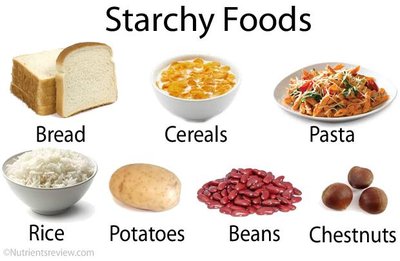
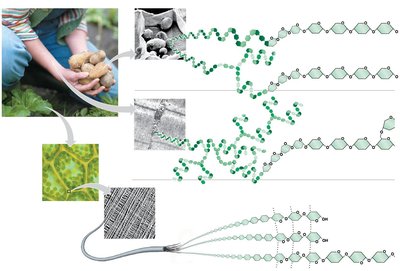
Starch: Main storage polysaccharide in plants, composed of amylose (unbranched) and amylopectin (branched).
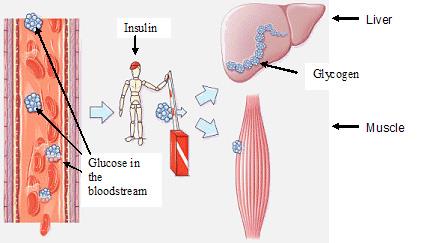
Glycogen: Main storage polysaccharide in animals, highly branched structure, stored in liver and muscle cells.
Structural Homopolysaccharides:
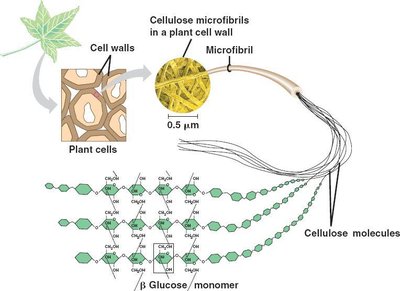
Cellulose: Primary structural component of plant cell walls, linear polymer of D-glucose linked by β(1→4) glycosidic bonds.
Chitin: Main structural component of exoskeletons of invertebrates, linear polymer of N-acetyl-D-glucosamine linked by β(1→4) glycosidic bonds.
Comparison of Starch, Glycogen, and Cellulose
Polysaccharide | Monomer | Bond Type | Structure | Function |
|---|---|---|---|---|
Starch | Glucose | α(1→4), α(1→6) at branches | Helical, branched (amylopectin) | Energy storage in plants |
Glycogen | Glucose | α(1→4), α(1→6) at branches | Highly branched | Energy storage in animals |
Cellulose | Glucose | β(1→4) | Straight, unbranched | Structural in plant cell walls |
Biological Importance and Digestion
Enzymes that digest starch by hydrolyzing α linkages cannot hydrolyze β linkages in cellulose.
Cellulose in human food acts as insoluble fiber, passing through the digestive tract undigested.
Some microbes can digest cellulose, and many herbivores rely on symbiotic relationships with these microbes for cellulose digestion.
Summary Table: Types of Carbohydrates
Type | Example | Bond | Function |
|---|---|---|---|
Monosaccharide | Glucose, Fructose | — | Energy source |
Disaccharide | Sucrose, Lactose, Maltose | Glycosidic | Transport, energy |
Polysaccharide | Starch, Glycogen, Cellulose, Chitin | Glycosidic | Storage, structure |
