 Back
BackBiomolecules: Structure, Function, and Biological Importance
Study Guide - Smart Notes
 Tailored notes based on your materials, expanded with key definitions, examples, and context.
Biomolecules: The Foundation of Life
Overview of Biomolecules
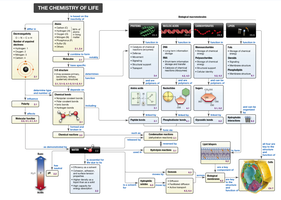
Biomolecules are essential macromolecules required for life, each with unique structures and functions. The four major classes are carbohydrates, proteins, nucleic acids, and lipids. Understanding their properties and roles is fundamental to grasping cellular and organismal biology.
Carbohydrates: Energy storage, structure, and cell recognition
Proteins: Catalysis, structure, transport, signaling, and more
Nucleic Acids: Information storage and transfer
Lipids: Membrane structure, energy storage, signaling (not covered in detail here)
Carbohydrates
Structure and Classification
Carbohydrates are polymers of simple sugars (monosaccharides) and serve as energy sources, structural materials, and cell identity markers. They are classified by the number of sugar units:
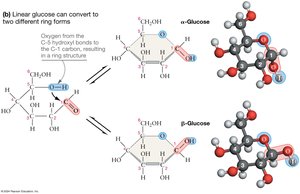
Monosaccharides: Single sugar units (e.g., glucose, 3C to 6C, can be linear or ringed)
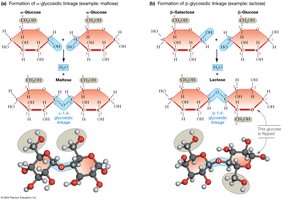
Disaccharides: Two monosaccharides linked by covalent bonds
Oligosaccharides: 3–20 monosaccharides
Polysaccharides: Hundreds or thousands of monosaccharides
General formula:
Formation of Glycosidic Bonds
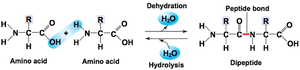
Monosaccharides join via glycosidic bonds through condensation (dehydration) reactions, releasing water. The bond can be α or β, depending on the configuration of the ringed sugar.
Polysaccharide Structure and Function
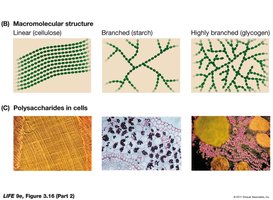
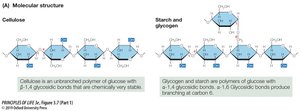
Polysaccharides can be linear or branched, depending on the types of glycosidic bonds:
Cellulose: Linear, β-1,4 glycosidic bonds (structural in plants)
Starch: Branched, α-1,4 and α-1,6 glycosidic bonds (energy storage in plants)
Glycogen: Highly branched, α-1,4 and α-1,6 glycosidic bonds (energy storage in animals)
Biological Roles of Carbohydrates
Energy storage (starch in plants, glycogen in animals)
Structural support (cellulose in plant cell walls, chitin in exoskeletons)
Cell recognition and signaling (glycoproteins, glycolipids)
Proteins
Structure and Monomers
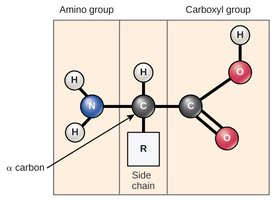
Proteins are polymers of amino acids, which are linked by peptide bonds. Each amino acid contains an amino group, a carboxyl group, a hydrogen atom, and a unique side chain (R group) attached to a central α-carbon.
Peptide Bond Formation
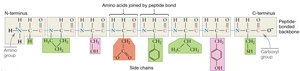
Amino acids are joined by peptide bonds through condensation reactions, forming polypeptides with distinct N-terminus (amino end) and C-terminus (carboxyl end).
Levels of Protein Structure
Primary structure (1°): Linear sequence of amino acids (determines higher-level structures)
Secondary structure (2°): Local folding into α-helices and β-pleated sheets, stabilized by hydrogen bonds
Tertiary structure (3°): Overall 3D shape, stabilized by interactions among R groups (hydrogen bonds, ionic bonds, van der Waals forces, disulfide bridges)
Quaternary structure (4°): Association of multiple polypeptide subunits
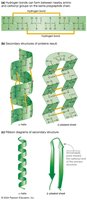
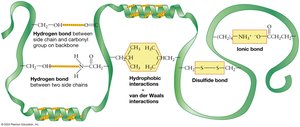
Protein Folding and Function
Protein function depends on correct folding into specific 3D shapes. Denaturation (unfolding) disrupts function but can sometimes be reversed. Chaperone proteins assist in proper folding. Misfolded proteins (prions) can cause disease.
Protein Diversity and Roles
Enzymes (catalysis)
Structural proteins (e.g., collagen, keratin)
Transport proteins (e.g., hemoglobin)
Signaling molecules (e.g., hormones)
Defense (e.g., antibodies)
Nucleic Acids
Structure and Monomers
Nucleic acids are polymers of nucleotides, each composed of a phosphate group, a pentose sugar (ribose or deoxyribose), and a nitrogenous base. DNA and RNA are the two main types.
Polymerization and Bonds
Nucleotides are joined by phosphodiester bonds (condensation reactions) to form the sugar-phosphate backbone of nucleic acids. Nucleic acids have directionality (5' to 3').
Functions of Nucleic Acids and Nucleotides
DNA: Stores genetic information for protein synthesis (double helix structure)
RNA: Various roles in protein synthesis, gene regulation, and catalysis
ATP, GTP, cAMP: Energy transfer and cell signaling (as monomers)
Base Pairing and Information Storage
Hydrogen bonds between complementary bases (A-T/U, G-C) stabilize the double helix in DNA and secondary structures in RNA. The sequence of bases encodes genetic information.
Summary Table: Biomolecules
Biomolecule | Monomer | Bond Type | Main Functions |
|---|---|---|---|
Carbohydrate | Monosaccharide | Glycosidic bond | Energy storage, structure, cell recognition |
Protein | Amino acid | Peptide bond | Catalysis, structure, transport, signaling |
Nucleic Acid | Nucleotide | Phosphodiester bond | Information storage, protein synthesis |
Key Concepts and Practice Questions
Condensation (dehydration) reactions build polymers by removing water.
Hydrolysis reactions break polymers into monomers by adding water.
Monomer identification is crucial for classifying biomolecules.
Structure determines function in all biomolecules.
