 Back
BackBiotechnology: Cloning, Genetic Engineering, and Genomics
Study Guide - Smart Notes
 Tailored notes based on your materials, expanded with key definitions, examples, and context.
Cloning of Plants and Animals
Totipotency and Plant Cloning
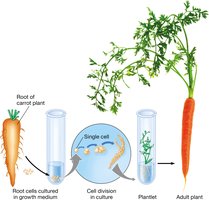
Plant cells are totipotent, meaning each cell has the genetic potential to develop into any type of specialized cell. This property allows for the regeneration of whole plants from single cells, as all cells contain identical DNA.
Totipotency: The ability of a single cell to divide and produce all differentiated cells in an organism.
Application: Used in agriculture to propagate desirable plant varieties.
Example: Carrot root cells can be cultured to produce new carrot plants.
Animal Cloning and Regeneration
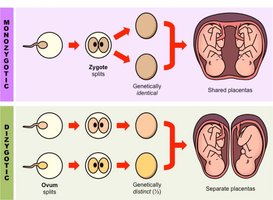
Some animals can regenerate lost body parts, but true cloning in animals involves producing genetically identical individuals. Identical twins are a natural example, formed when a single embryo splits into two.
Identical Twins (Monozygotic): Result from the splitting of a single fertilized egg, producing genetically identical offspring.
Fraternal Twins (Dizygotic): Result from two separate eggs fertilized by two sperm, genetically distinct.
Reproductive Cloning in Animals
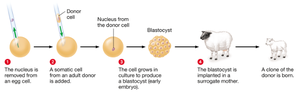
Reproductive cloning produces new, genetically identical individuals. This can be achieved by artificially splitting embryos or by nuclear transplantation, where the nucleus from an adult cell is transferred into an enucleated egg cell.
Nuclear Transplantation: The nucleus of a donor somatic cell is inserted into an egg cell that has had its nucleus removed.
Applications: Used in agriculture and research to replicate valuable animals.
Limitations: Low success rates, potential health issues, and ethical concerns.
Therapeutic Cloning and Stem Cells
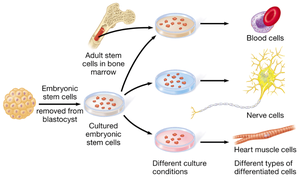
Therapeutic cloning uses embryonic stem cells to treat diseases, without producing a live organism. Embryonic stem cells can differentiate into over 200 cell types, while adult stem cells have more limited potential.
Therapeutic Cloning: Generation of embryonic stem cells for medical treatment, not for reproduction.
Stem Cells: Cells with the ability to differentiate into various specialized cell types.
Gene Cloning and Editing
Key Terms in Biotechnology
Biotechnology: Manipulation of living organisms or their components to produce useful products.
DNA Technology: Techniques for studying and manipulating DNA, including recombinant DNA methods.
Genetic Engineering: Direct manipulation of genes for practical purposes.
Gene Cloning Process
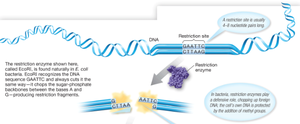
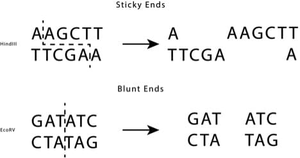
Gene cloning involves making multiple copies of a gene of interest. This is achieved by cutting DNA with restriction enzymes at specific sequences, producing fragments with either sticky or blunt ends.
Restriction Enzymes: Proteins that cut DNA at specific nucleotide sequences (restriction sites).
Sticky Ends: Overhanging single-stranded DNA ends that can easily pair with complementary sequences.
Blunt Ends: Straight cuts with no overhangs.
Restriction Enzyme Recognition Sites
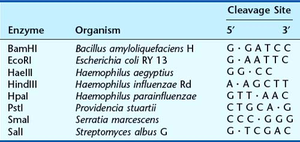
Different restriction enzymes recognize and cut specific DNA sequences. The table below summarizes some common enzymes and their recognition sites.
Enzyme | Organism | Cleavage Site (5' → 3') |
|---|---|---|
BamHI | Bacillus amyloliquefaciens H | G^GATCC |
EcoRI | Escherichia coli RY 13 | G^AATTC |
HaeIII | Haemophilus aegyptius | GG^CC |
HindIII | Haemophilus influenzae Rd | A^AGCTT |
HpaI | Haemophilus parainfluenzae | GTT^AAC |
PstI | Providencia stuartii | CTGCA^G |
SmaI | Serratia marcescens | CCC^GGG |
SalI | Streptomyces albus G | G^TCGAC |
Vectors and Recombinant DNA
To clone a gene, the DNA fragment is inserted into a vector, such as a plasmid, which can replicate independently in a host cell. Both the vector and the gene of interest are cut with the same restriction enzyme to ensure compatible ends. DNA ligase then joins the fragments, forming recombinant DNA.
Vector: DNA molecule used as a vehicle to transfer genetic material into a host cell.
DNA Ligase: Enzyme that joins DNA fragments by forming phosphodiester bonds.
Finding Genes and cDNA
Scientists use nucleic acid probes to locate specific genes. A major challenge in expressing eukaryotic genes in prokaryotes is the presence of introns. To overcome this, complementary DNA (cDNA) is synthesized from mRNA using reverse transcriptase, ensuring only coding sequences are present.
Nucleic Acid Probe: Labeled DNA or RNA sequence used to detect the presence of complementary sequences.
cDNA: DNA synthesized from an mRNA template, containing only exons.
Reverse Transcriptase: Enzyme that synthesizes DNA from an RNA template.
Genetically Modified Organisms (GMOs)
Definition and Applications
GMOs are organisms whose genomes have been altered using biotechnology. If the introduced gene comes from a different species, the organism is called transgenic. GMOs are used in agriculture, medicine, and research.
Transgenic Organism: Contains genes from another species.
Applications: Production of insulin in bacteria, disease-resistant crops, and animal models for research.
Examples of Transgenic Organisms
Bacteria: Produce human proteins like insulin.
Mice: Used for medical research.
Goats: Produce therapeutic proteins in milk.
GMO Crops: Engineered for improved nutrition and resistance to environmental stress.
Ethical and Environmental Concerns
Potential health effects and environmental risks.
Ethical debates about human genetic modification and eugenics.
Concerns about genetic homogeneity and unforeseen consequences.
Gene Therapy
Principles and Applications
Gene therapy involves altering an individual's genes to treat or prevent disease. It is being tested for a variety of conditions, including genetic disorders and some cancers.
Gene Therapy: Introduction, removal, or alteration of genetic material within a person's cells to treat disease.
Bioethics: The study of ethical issues emerging from advances in biology and medicine, especially regarding genetic modification.
DNA Profiling
Polymerase Chain Reaction (PCR)
PCR is a technique used to amplify specific DNA sequences rapidly. It uses primers, nucleotides, and a heat-stable DNA polymerase (Taq polymerase) to double the amount of DNA with each cycle.
Steps: Denaturation (heating to separate strands), annealing (cooling to attach primers), extension (DNA synthesis).
Applications: Forensics, paternity testing, genetic research.
Short Tandem Repeat (STR) Analysis
STR analysis examines regions of non-coding DNA where short sequences are repeated. The number of repeats varies among individuals, making STRs useful for identification.
STR: Short sequences of DNA repeated in tandem, highly variable among individuals.
Gel Electrophoresis: Technique to separate DNA fragments by size using an electric field.
Gel Electrophoresis
Gel electrophoresis separates DNA fragments by length. DNA samples are loaded into a gel, and an electric current pulls the negatively charged DNA toward the positive end. Shorter fragments move faster, forming distinct bands.
Marker Lane: Contains DNA fragments of known sizes for comparison.
Applications of DNA Profiling
Criminal investigations and exoneration of innocent individuals.
Paternity and kinship testing.
Tracking genetic mutations and ancestry.
Genomics and Bioinformatics
DNA Sequencing
DNA sequencing determines the order of nucleotides in a DNA molecule. Modern methods use electronic monitors to identify each base as it is added during replication.
Genome: The complete set of genetic material in an organism.
Genomics: The study and comparison of genomes within and between species.
Human Genome Project
The Human Genome Project mapped and sequenced all human DNA, revealing that much of our DNA does not code for proteins but consists of regulatory and repetitive sequences. Comparing genomes helps identify genes related to diseases.
Applications: Disease gene identification, evolutionary studies, personalized medicine.
