 Back
BackCell Biology and Microscopy Study Guide
Study Guide - Smart Notes
 Tailored notes based on your materials, expanded with key definitions, examples, and context.
Q1. Which instrument is best for magnifying a pollen grain 8,000 times and examining its surface ridges and pores?
Background
Topic: Microscopy and Cell Structure
This question tests your understanding of different types of microscopes and their capabilities, especially regarding magnification and surface detail.
Key Terms:
Light Microscope: Uses visible light to magnify specimens, typically up to 1,000–2,000x.
Transmission Electron Microscope (TEM): Provides high magnification and resolution for internal cell structures.
Scanning Electron Microscope (SEM): Used for detailed surface imaging at high magnification.
Step-by-Step Guidance
Consider the magnification required (8,000x) and whether surface detail or internal structure is needed.
Recall that light microscopes (inverted or compound) generally do not reach 8,000x magnification.
Compare the capabilities of TEM and SEM: TEM is for internal structures, SEM is for surface details.
Identify which instrument is specifically designed for examining surface features at high magnification.
Try solving on your own before revealing the answer!
Final Answer: a scanning electron microscope
SEM is ideal for high-magnification surface imaging, making it the best choice for examining ridges and pores on a pollen grain.
Q2. How can you make a cough drop last longer in your mouth?
Background
Topic: Surface Area to Volume Ratio
This question tests your understanding of how surface area and volume affect the rate of dissolution.
Key Terms:
Surface Area: The total area exposed to the environment.
Volume: The total space occupied by the object.
Surface Area to Volume Ratio: Determines how quickly substances dissolve or react.
Step-by-Step Guidance
Recall that increasing surface area (breaking into pieces) increases the rate of dissolution.
Consider how keeping the drop whole affects the surface area to volume ratio.
Think about which option would slow down the dissolving process, making the drop last longer.
Evaluate the choices based on their effect on surface area and dissolution rate.
Try solving on your own before revealing the answer!
Final Answer: Keep the cough drop whole.
Keeping the drop whole maintains the smallest surface area to volume ratio, slowing dissolution and making it last longer.
Q4. If you see cell walls and membrane-bound organelles under a microscope, what type of cells are you observing?
Background
Topic: Cell Types and Structures
This question tests your ability to distinguish between plant, animal, and bacterial cells based on visible features.
Key Terms:
Cell Wall: Found in plant and bacterial cells, not animal cells.
Membrane-bound Organelles: Found in eukaryotic cells (plant and animal), not prokaryotic (bacterial) cells.
Step-by-Step Guidance
Recall which cell types have cell walls and membrane-bound organelles.
Consider that bacterial cells lack membrane-bound organelles.
Plant cells have both cell walls and membrane-bound organelles.
Animal cells lack cell walls.
Try solving on your own before revealing the answer!
Final Answer: are plant cells
Plant cells are the only type with both cell walls and membrane-bound organelles.
Q7. What is the correct order of structures for insulin secretion from pancreatic cells?
Background
Topic: Protein Synthesis and Secretion Pathway
This question tests your knowledge of the cellular pathway for protein secretion.
Key Terms:
Rough ER: Site of protein synthesis.
Transport Vesicles: Move proteins between organelles.
Golgi Apparatus: Modifies and packages proteins.
Cell Membrane: Site of secretion.
Step-by-Step Guidance
Recall the pathway: proteins are synthesized in the rough ER.
Proteins are transported via vesicles to the Golgi apparatus.
Golgi apparatus modifies and packages proteins for secretion.
Transport vesicles carry proteins to the cell membrane for release.
Try solving on your own before revealing the answer!
Final Answer: rough ER, transport vesicles, Golgi apparatus, transport vesicles, cell membrane
This is the typical pathway for protein secretion in eukaryotic cells.
Q8. Which cell junction best facilitates communication between nerve cells?
Background
Topic: Cell Junctions and Communication
This question tests your understanding of cell junctions and their roles in cell communication.
Key Terms:
Gap Junctions: Allow direct communication between cells.
Tight Junctions: Prevent leakage between cells.
Anchoring Junctions: Provide structural support.
Step-by-Step Guidance
Recall which junctions allow passage of ions and signals between cells.
Consider the function of nerve cells and their need for rapid communication.
Evaluate which junction type is specialized for this purpose.
Try solving on your own before revealing the answer!
Final Answer: gap junctions
Gap junctions allow direct transfer of signals between adjacent cells.
Q9. Which organelle would you expect melanocytes in the skin to have more of, based on their function?
Background
Topic: Cell Organelles and Function
This question tests your understanding of organelle abundance based on cell function.
Key Terms:
Melanocytes: Cells that produce melanin.
Lysosomes: Organelles involved in breakdown and recycling.
Chloroplasts: Found in plant cells, not skin cells.
Ribosomes: Sites of protein synthesis.
Step-by-Step Guidance
Recall the function of melanocytes (melanin production).
Consider which organelle is involved in synthesizing proteins and enzymes needed for melanin production.
Eliminate organelles not found in skin cells (e.g., chloroplasts).
Think about which organelle would be more abundant in cells with high protein synthesis activity.
Try solving on your own before revealing the answer!
Final Answer: ribosomes
Melanocytes produce melanin, requiring high protein synthesis, so they have more ribosomes.
Q10. Is this an animal or plant cell? Explain your answer.
Background
Topic: Cell Structure Identification
This question tests your ability to distinguish between animal and plant cells based on visible organelles.
Key Terms:
Animal Cell: Lacks cell wall and chloroplasts, may have lysosomes.
Plant Cell: Has cell wall, chloroplasts, and large central vacuole.
Step-by-Step Guidance
Examine the cell diagram for presence or absence of cell wall and chloroplasts.
Look for organelles unique to animal cells, such as lysosomes.
Identify features that distinguish animal from plant cells.
Use these observations to determine the cell type.
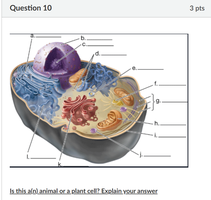
Try solving on your own before revealing the answer!
Final Answer: Animal cell
The cell lacks a cell wall and chloroplasts, and contains lysosomes, indicating it is an animal cell.
Q11. Organelle Identification Questions
Background
Topic: Cell Organelles and Their Functions
These questions test your ability to identify organelles and their functions in a cell diagram.
Key Terms:
ATP: Energy molecule produced by mitochondria.
Lipids: Synthesized by smooth ER.
Organelle: Specialized structure within a cell.
Step-by-Step Guidance
Refer to the cell diagram and locate the letters "K" and "C".
Recall the appearance and function of each organelle (e.g., mitochondria, smooth ER).
Identify which letter points to the organelle responsible for ATP production (mitochondria).
Identify which letter points to the organelle responsible for lipid synthesis (smooth ER).
Try solving on your own before revealing the answer!
Final Answers:
K: Mitochondria
C: Smooth Endoplasmic Reticulum
ATP production: K (Mitochondria)
Lipid synthesis: C (Smooth ER)
These organelles are identified based on their structure and function in the cell diagram.
