 Back
BackCell Cycle and Chromosome Counting Study Guide
Study Guide - Smart Notes
 Tailored notes based on your materials, expanded with key definitions, examples, and context.
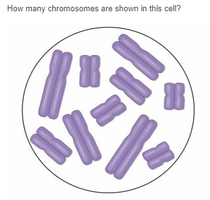
Q1. How many chromosomes are shown in this cell?
Background
Topic: Chromosome Counting in Cell Biology
This question tests your ability to visually identify and count chromosomes in a cell, which is fundamental for understanding cell division and genetic inheritance.
Key Terms:
Chromosome: A structure made of DNA and proteins that carries genetic information.
Chromatid: Each of the two thread-like strands into which a chromosome divides during cell division.
Step-by-Step Guidance
Carefully observe the diagram and identify each distinct chromosome. Remember, each chromosome is counted as a single unit, regardless of whether it consists of one or two chromatids.
Count the number of chromosome structures present inside the cell boundary. Do not count chromatids separately; focus on the entire chromosome.
Compare your count to the answer choices provided (2, 5, 10, 20) and select the one that matches your total.
Try solving on your own before revealing the answer!
Final Answer: 10 chromosomes
There are 10 distinct chromosome structures shown in the cell diagram. Each chromosome is counted as a single unit, regardless of the number of chromatids.
Q2. If a eukaryotic cell is in the G1 phase of the cell cycle, which statement about the cell’s chromosomes must be correct?
Background
Topic: Cell Cycle Phases
This question tests your understanding of the characteristics of chromosomes during the G1 phase, which is the first gap phase after cell division and before DNA replication.
Key Terms:
G1 Phase: The first phase of interphase, where the cell grows and prepares for DNA replication.
Chromatid: The single DNA molecule that makes up a chromosome before replication.
Chromatin: The complex of DNA and proteins that forms chromosomes.
Step-by-Step Guidance
Recall that during G1, chromosomes have not yet replicated, so each chromosome consists of a single chromatid.
Consider the structure of chromosomes in G1: they are made of DNA and associated proteins (chromatin).
Evaluate the answer choices and eliminate those that do not fit the characteristics of G1 phase chromosomes.
Try solving on your own before revealing the answer!
Final Answer: Each chromosome is made of a complex of DNA and associated proteins.
In G1, chromosomes are single chromatids composed of chromatin, not two identical chromatids.
Q3. Which statement provides the best description of the interphase portion of the cell cycle?
Background
Topic: Interphase in the Cell Cycle
This question tests your understanding of what happens during interphase, which is the period between cell divisions when the cell grows, replicates DNA, and prepares for mitosis.
Key Terms:
Interphase: The phase of the cell cycle during which the cell is not dividing but is metabolically active.
Mitosis: The process of cell division.
Step-by-Step Guidance
Recall that interphase includes G1, S, and G2 phases, during which the cell grows, replicates DNA, and prepares for division.
Consider whether interphase is a resting stage or an active stage for the cell.
Evaluate the answer choices and select the one that best describes the metabolic activity of the cell during interphase.
Try solving on your own before revealing the answer!
Final Answer: During interphase, a cell is metabolically active.
Interphase is not a resting stage; the cell is actively growing, replicating DNA, and preparing for division.
Q4. What is true of all cancers?
Background
Topic: Cancer Biology and Cell Cycle Regulation
This question tests your understanding of the fundamental characteristics of cancer cells, particularly their relationship to cell cycle control.
Key Terms:
Cancer: A disease characterized by uncontrolled cell division.
Cell Cycle Controls: Mechanisms that regulate the progression of cells through the cell cycle.
Step-by-Step Guidance
Recall that cancer cells are defined by their ability to divide uncontrollably.
Consider whether all cancers are caused by chemical carcinogens or inherited.
Focus on the common feature of all cancers related to cell cycle regulation.
Try solving on your own before revealing the answer!
Final Answer: They have escaped normal cell cycle controls.
All cancers share the characteristic of uncontrolled cell division due to loss of cell cycle regulation.
Q5. How do cancer cells differ from normal cells?
Background
Topic: Cancer Cell Characteristics
This question tests your understanding of the differences between cancer cells and normal cells, especially in terms of growth and behavior in culture.
Key Terms:
Immortal: Ability to divide indefinitely.
Anchorage Dependence: Requirement for cells to be attached to a surface to grow.
Step-by-Step Guidance
Recall that cancer cells can divide indefinitely, unlike normal cells.
Consider whether cancer cells exhibit anchorage dependence or independence.
Evaluate the answer choices and select the one that accurately describes cancer cell behavior.
Try solving on your own before revealing the answer!
Final Answer: Cancer cells may be immortal.
Cancer cells can divide indefinitely and often lose anchorage dependence.
