 Back
BackCell Division and Reproduction: Prokaryotic and Eukaryotic Cell Cycles
Study Guide - Smart Notes
 Tailored notes based on your materials, expanded with key definitions, examples, and context.
Cell Division and Reproduction
Types of Reproduction
Cell division is fundamental to the life cycle of all organisms, enabling reproduction, growth, and maintenance. There are two primary modes of reproduction:
Asexual reproduction: Offspring are genetically identical to the parent, inheriting all genes from a single parent. This process is common in prokaryotes and some eukaryotes.
Sexual reproduction: Offspring inherit unique combinations of genes from two parents, resulting in genetic variation. This process is typical in most eukaryotes.
Prokaryotic Cell Division: Binary Fission
Binary Fission Process
Prokaryotes, such as bacteria and archaea, reproduce by binary fission, a simple and efficient process:
Chromosome Structure: Prokaryotic chromosomes are usually a single, circular DNA molecule associated with proteins and are much smaller than eukaryotic chromosomes.
Steps of Binary Fission:
Duplication of the chromosome and separation of the copies
Continued elongation of the cell and movement of the chromosome copies
Division into two daughter cells
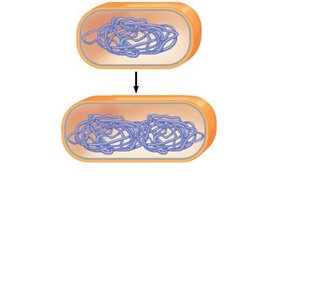
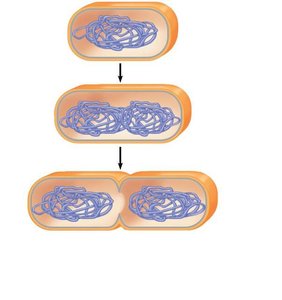
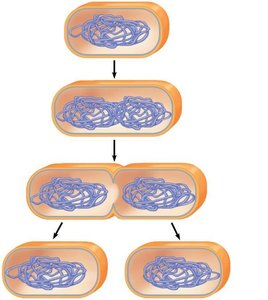
Bacterial DNA Supercoiling
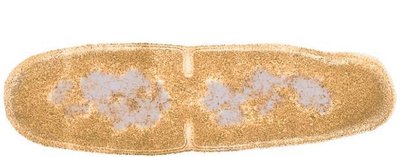
Supercoiling is a process by which bacterial DNA is compacted to fit within the cell. This is essential for efficient chromosome segregation during binary fission.
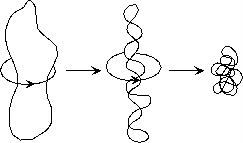
Prokaryotic Chromosomes
Prokaryotic chromosomes are visualized as tightly packed DNA within the cell, facilitating rapid cell division.
Eukaryotic Cell Cycle and Mitosis
Chromosome Complexity
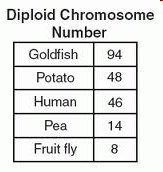
Eukaryotic cells are larger and more complex than prokaryotic cells, containing multiple chromosomes within a nucleus. Each species has a characteristic chromosome number.
Human cells: 46 chromosomes
Goldfish: 94 chromosomes
Potato: 48 chromosomes
Pea: 14 chromosomes
Fruit fly: 8 chromosomes
Organism | Diploid Chromosome Number |
|---|---|
Goldfish | 94 |
Potato | 48 |
Human | 46 |
Pea | 14 |
Fruit fly | 8 |
Genome Size and Complexity
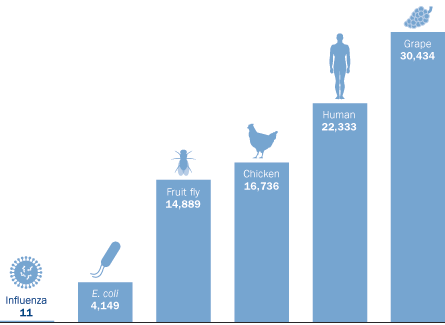
The human genome contains approximately 20,000–23,000 protein-coding genes, with a total DNA length of about 3 meters per cell. Genome size and gene number vary widely among organisms.
Organism | Protein-Coding Genes |
|---|---|
Influenza | 11 |
E. coli | 4,149 |
Fruit fly | 14,889 |
Chicken | 16,736 |
Human | 22,333 |
Grape | 30,434 |
Karyotype
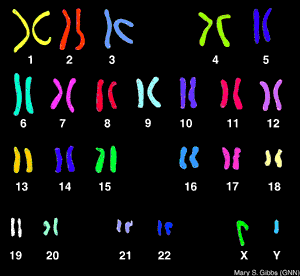
A karyotype is a visual representation of the chromosomes in a cell, used to identify chromosome number and structure.
Chromatin and Chromosome Structure
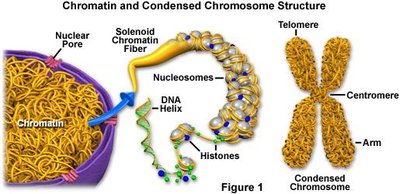
Chromatin is the complex of DNA and proteins found in the nucleus. During cell division, chromatin condenses to form visible chromosomes. Chromosome structure includes:
DNA helix wrapped around histone proteins to form nucleosomes
Solenoid chromatin fiber further compacts the DNA
Condensed chromosome with distinct arms, centromere, and telomere
The Cell Cycle
Phases of the Cell Cycle
The cell cycle is an ordered sequence of events from cell formation to division. It consists of two main stages:
Interphase: Cell grows and duplicates its contents.
G1 phase: Growth, organelle duplication, increase in cytoplasm
S phase: DNA synthesis, chromosome duplication, centrosome duplication
G2 phase: Further growth, organelle duplication, preparation for division
Mitotic phase: Cell divides.
Mitosis: Division of the nucleus
Cytokinesis: Division of the cytoplasm
Surface Area to Volume Ratio
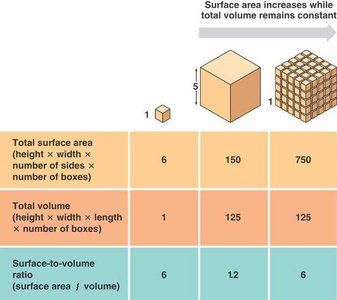
As cells grow, their surface area-to-volume ratio changes, affecting their ability to exchange materials efficiently. This ratio is crucial for cell function and division.
Box Size | Total Surface Area | Total Volume | Surface-to-Volume Ratio |
|---|---|---|---|
Small (1x1x1) | 6 | 1 | 6 |
Medium (5x5x5) | 150 | 125 | 1.2 |
Large (5x5x5, split into 125 small boxes) | 750 | 125 | 6 |
Summary
Cell division is essential for reproduction, growth, and maintenance in all organisms.
Prokaryotes divide by binary fission, while eukaryotes undergo a complex cell cycle including mitosis.
Chromosome number and genome size vary among species, influencing genetic complexity.
Surface area-to-volume ratio is a key factor in cell division and function.
