 Back
BackCell Division and the Genetic Basis of Inheritance
Study Guide - Smart Notes
 Tailored notes based on your materials, expanded with key definitions, examples, and context.
The Cell Cycle and Cell Division
Most Cell Division Results in Genetically Identical Daughter Cells
Cell division is a fundamental process in all living organisms, essential for growth, development, and tissue repair. Most cell divisions produce daughter cells that are genetically identical to the parent cell, ensuring continuity of genetic information across generations of cells.
Cell Division: The process by which a parent cell divides into two or more daughter cells. In eukaryotes, this typically involves mitosis and cytokinesis.
Genetically Identical Cells: Daughter cells produced by mitosis contain the same genetic material as the parent cell, barring rare mutations.
Importance: Cell division is crucial for organismal growth, tissue repair, and asexual reproduction.
Key Roles of Cell Division
Cell division serves several important roles in multicellular organisms:
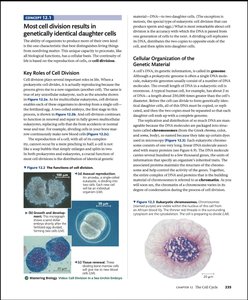
Growth: Organisms grow by increasing the number of cells through repeated cell divisions.
Repair: Damaged or dead cells are replaced by new cells produced through division.
Reproduction: In unicellular organisms, cell division is the primary means of reproduction. In multicellular organisms, specialized cell divisions produce gametes for sexual reproduction.
Cellular Organization of the Genetic Material
Chromosomes and DNA
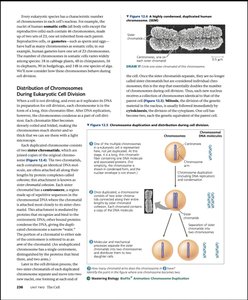
Genetic information is stored in the form of DNA, which is organized into structures called chromosomes. Each eukaryotic species has a characteristic number of chromosomes in its cell nucleus.
Chromosome: A DNA molecule packaged with proteins, carrying genetic information.
Somatic Cells: All body cells except gametes; contain a full set of chromosomes (diploid).
Gametes: Reproductive cells (sperm and eggs); contain half the number of chromosomes (haploid).
Distribution of Chromosomes During Eukaryotic Cell Division
During cell division, chromosomes are duplicated and evenly distributed to daughter cells. This ensures that each new cell receives an identical set of genetic instructions.
Chromosome Duplication: Before a cell divides, its chromosomes are replicated, resulting in two sister chromatids joined at a region called the centromere.
Mitosis: The process by which the duplicated chromosomes are separated into two nuclei.
Cytokinesis: The division of the cytoplasm, resulting in two distinct daughter cells.
Cell Division in the Human Life Cycle
Somatic Cells and Gametes
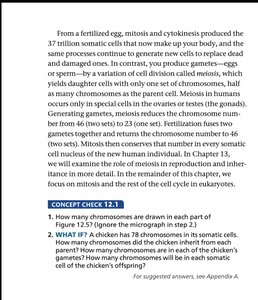
In humans, somatic cells undergo mitosis to produce identical cells for growth and repair. Gametes are produced by a different process called meiosis, which reduces the chromosome number by half.
Somatic Cells: Contain 46 chromosomes (23 pairs) in humans.
Gametes: Contain 23 chromosomes (one set), ensuring that fertilization restores the diploid number.
Fertilization: The fusion of gametes restores the diploid chromosome number in the zygote.
Concept Check
How many chromosomes are drawn in each part of the chromosome duplication diagram?
What if a chicken has 78 chromosomes in its somatic cells? How many chromosomes are in each gamete?
Additional info: The process of mitosis ensures genetic continuity, while meiosis introduces genetic diversity through recombination and independent assortment. These processes are fundamental to inheritance and evolution.
