 Back
Cell Division: Mitosis and Meiosis – Structure, Function, and Genetic Consequences
Study Guide - Smart Notes
 Tailored notes based on your materials, expanded with key definitions, examples, and context.
Chapter 12: The Cell Cycle
The Life Cycle of a Cell
The cell cycle is the series of events that cells go through as they grow and divide. It ensures the accurate duplication and distribution of genetic material to daughter cells. Cell division is essential for growth, repair, and reproduction in all living organisms.
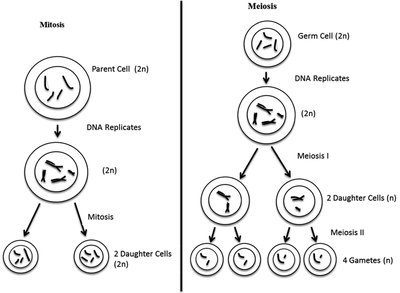
Mitosis: Division of somatic (body) cells, producing two genetically identical daughter cells.
Meiosis: Division of germ cells, producing gametes (sperm and eggs) with half the chromosome number of the parent cell.
Cytokinesis: Division of the cytoplasm, following nuclear division.
The Cell Cycle Phases
Interphase: Non-dividing phase; includes G1 (growth), S (DNA synthesis/replication), and G2 (preparation for mitosis).
M phase: Includes mitosis (nuclear division) and cytokinesis (cytoplasmic division).
During interphase, chromosomes are uncoiled and DNA is replicated. In M phase, chromosomes condense and are distributed to daughter cells.
Chromosome Structure
Chromosome: DNA molecule wrapped around histone proteins.
Homologous chromosomes: Chromosome pairs, one from each parent, carrying the same genes but possibly different alleles.
Sister chromatids: Identical copies of a chromosome, attached at the centromere after DNA replication.
Mitosis: Phases and Mechanisms
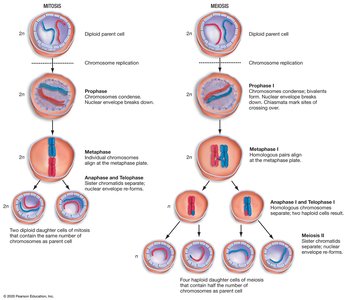
Mitosis ensures equal distribution of replicated chromosomes to two daughter cells. The phases are:
Prophase: Chromosomes condense; spindle apparatus forms.
Prometaphase: Nuclear envelope breaks down; microtubules attach to kinetochores.
Metaphase: Chromosomes align at the metaphase plate.
Anaphase: Sister chromatids separate and move to opposite poles.
Telophase: Nuclear envelopes reform; chromosomes decondense.
Cytokinesis: Cytoplasm divides, forming two identical daughter cells.
Control of the Cell Cycle
Cell cycle progression is regulated by checkpoints and molecular signals:
G1 checkpoint: Checks for cell size, nutrients, DNA damage, and social signals.
G2 checkpoint: Ensures DNA replication is complete and undamaged.
M checkpoint: Ensures all chromosomes are properly attached to the spindle before separation.
MPF (M-phase-promoting factor): A cyclin-dependent kinase complex that triggers entry into M phase.
Defects in checkpoint regulation can lead to uncontrolled cell division and cancer.
Chapter 13: Meiosis
Introduction to Meiosis
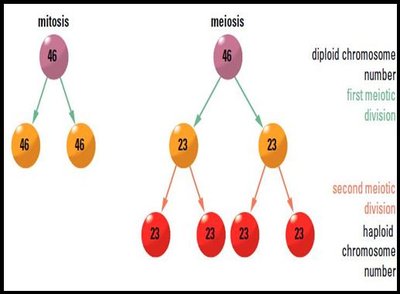
Meiosis is a specialized form of cell division that reduces the chromosome number by half, producing haploid gametes. It is essential for sexual reproduction and genetic diversity.
Diploid (2n): Cells with two sets of chromosomes (one from each parent).
Haploid (n): Cells with one set of chromosomes.
Fertilization: Fusion of two gametes, restoring diploid chromosome number.
Phases of Meiosis
Meiosis consists of two sequential divisions: Meiosis I and Meiosis II.
Meiosis I: Homologous chromosomes separate, reducing chromosome number by half.
Meiosis II: Sister chromatids separate, similar to mitosis.
Key events:
Prophase I: Homologous chromosomes pair (synapsis) and exchange genetic material (crossing over).
Metaphase I: Homologous pairs align at the metaphase plate.
Anaphase I: Homologs separate to opposite poles.
Telophase I and Cytokinesis: Two haploid cells form.
Meiosis II: Similar to mitosis; sister chromatids separate, resulting in four haploid gametes.
Genetic Variation in Meiosis
Crossing Over: Exchange of genetic material between homologous chromosomes during Prophase I, creating new allele combinations.
Independent Assortment: Random orientation of homologous pairs during Metaphase I leads to genetic variation in gametes.
Random Fertilization: Further increases genetic diversity among offspring.
Comparison: Mitosis vs. Meiosis
Feature | Mitosis | Meiosis |
|---|---|---|
Number of divisions | 1 | 2 |
Number of daughter cells | 2 | 4 |
Chromosome number in daughter cells | Diploid (2n) | Haploid (n) |
Genetic identity | Identical to parent | Genetically unique |
Role | Growth, repair | Gamete production |
Chapter 14: Mendel and the Gene
Principles of Heredity
Gregor Mendel's experiments with pea plants established the basic principles of heredity:
Gene: A unit of heredity that encodes a trait.
Allele: Different versions of a gene.
Genotype: Genetic makeup of an organism.
Phenotype: Observable traits of an organism.
Homozygous: Two identical alleles for a gene.
Heterozygous: Two different alleles for a gene.
Dominant allele: Expressed in the phenotype when present.
Recessive allele: Masked by the dominant allele in heterozygotes.
Mendel's Laws
Law of Segregation: Two alleles for a gene segregate during gamete formation (Anaphase I of meiosis).
Law of Independent Assortment: Alleles of different genes assort independently during gamete formation (Metaphase I of meiosis).
Mendel's work laid the foundation for modern genetics and the understanding of inheritance patterns.
Additional info:
Images included above visually reinforce the differences between mitosis and meiosis, chromosome behavior, and the outcomes of each process.
Tables and diagrams are essential for comparing the processes and understanding the genetic consequences of cell division.
